

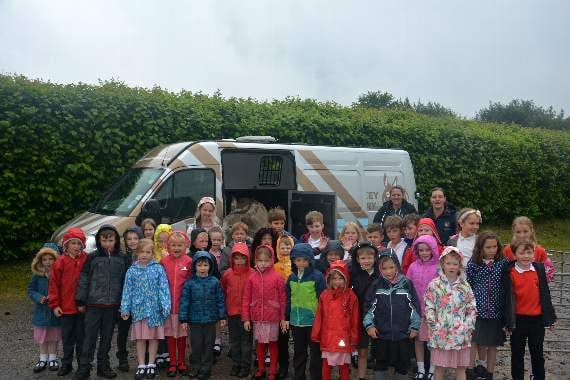
Children at Sampford Arundel Primary School welcomed four-legged visitors with an educational visit from The Donkey Sanctuary.
The visit began with an assembly from Rachel Page, education officer at The Donkey Sanctuary, who talked about understanding donkeys and their behaviour.
Rachel said: “I talked about the ways The Donkey Sanctuary helps donkeys in the UK and across the world. The children from class one and two were very enthusiastic and keen to ask questions.”
The youngsters also heard all about the work of The Donkey Sanctuary’s Veterinary Department from Luke Poore, head of Clinical Veterinary Services at the international animal welfare charity.


The organisation’s state-of-the-art donkey hospital is the largest of its kind in the world and a leading facility in the care and health of donkeys and mules.
Luke told the children about the work of the vets and nurses at the sanctuary. He said: “Sampford Arundel Primary School is an exceptional rural school and the children were extremely interested in the work of the sanctuary. Hopefully, we can inspire future generations to care for donkeys.”
One of the highlights for children and staff at the village primary school was meeting donkeys Jack and Little Butch.
The two donkeys from The Donkey Sanctuary in Sidmouth, were brought in to the school, where grooms from the sanctuary were on hand to answer any questions and to ensure everyone had the chance to meet them.
The visit was part of The Donkey Sanctuary’s education programme and is linked to personal, social, health and economic (PSHE) objectives for Key Stage one and Key Stage two primary school children. For the younger pupils this focusses on recognising the needs of living things and for children in Key Stage two includes reflecting on moral, social and cultural issues, using imagination to understand the experiences of other people and animals.
Rachel Page added: “Our school outreach visits ensure young people have a greater understanding of donkeys and promote animal welfare by identifying the characteristics and needs that are shared by all living things.”
In addition to working directly with schools, The Donkey Sanctuary has created a number of free teaching resources which are available through the TES (Times Education Supplement) website.
Carl Wholey, national schools education manager at The Donkey Sanctuary, said: “The resources are delivered in project-based learning formats. They are designed to provide cross-curricular learning which includes geography, art and design, design and technology, English and science. To date the ‘Animals, Plants and their Habitats’ series has had more than 50,000 downloads.”
In 2019 The Donkey Sanctuary celebrates its 50th anniversary. This milestone is an opportunity to both look back on the charity’s landmark achievements and take stock of the massive challenges in a world where the suffering of animals remains abhorrent.
Since its foundation by Dr Elisabeth Svendsen in 1969, The Donkey Sanctuary has grown from a charity rescuing UK donkeys from neglect and abuse, to an international welfare organisation transforming the lives of millions of donkeys and mules, and the people who depend on them for a living.
Comments
This article has no comments yet. Be the first to leave a comment.