

Talk on British Sign Language
THE president of Sampford Arundel Women’s Institute (WI) Susan Bellringer thanked all of the members who had braved coming to their meeting on such an awful evening.
The WI Remembrance wreath had been made with over knitted poppies and was laid at the War Memorial in Sampford Arundel on Remembrance Sunday, followed by a service in the church.
Taunton Early Birds WI has invited members of Sampford Arundel WI to the Tone Valley Group Carol and Songs event on Monday, December 8, this will be a warm up for the other Carol Service this week when members will be going to the county carol service in Wells.



This month's speaker was Emily Sharpe, who is a teacher of British Sign Language, who gave a beginners' guide to communicating with deaf people.
For deaf people with limited hearing or lip reading skills, speaking clearly will help, but please don't shout, speak slowly or exaggerate mouth movements.
Always make good eye contact and remember to wait until the person is looking at you before attempting to communicate.
She also said not to stand in front of a light, as the light would need to be on one’s face. Emily said that 40 per cent of over 50's have some form of hearing loss but not all Deaf people will sign.
There are 95 per cent of deaf children born to hearing parents, with only five per cent of households using sign language.
Emily finished her talk by giving a little test where she mouthed words without any gestures for members to recognise.
Ann thanked Emily for being such an enjoyable speaker and hoped that it would make the group more aware in the future.
The winning entry was a napkin ring with an embroidered napkin second and necklace third.
Social time involved solving a difficult collection of animal anagrams.
The December meeting is a members only evening but events will be held in 2026 as the WI meet at The Beambridge Inn at 7.30pm on the second Tuesday every month.
Talk on medical herbalists
KICKING off her talk at the November meeting of the Wellington & District Townswomen’s Guild, Tryphena Huntingford asked what a medical herbalist was.
A herbalist is a practitioner who uses plants, or mixtures of plant extracts, to treat illness and promote health, focusing on the patient and the underlying cause of their illness, rather than the symptoms they have.
Ms Huntingford, a professional herbalist who trained with the National Institute of Medical Herbalists, is based at Harpford Farm, between Holywell Lake and Langford Budville, where she grows around 50 species of plants for use in her medicines, as infusions, tinctures and creams.
Most are native plants and the majority are perennial. Plants used in herbal medicine range from food plants, such as broccoli, through spices and culinary herbs to plants that in the wrong hands could be harmful, such as belladonna.
A vote of thanks to Ms Huntingford for her informative talk was given by Jenny Bonwick, and then the chairman, secretary and treasurer gave their reports.
Members were reminded that December’s meeting would be the Christmas party on Monday, December 8, at Lodge Close Hall, so they should bring along a ‘Secret Santa’ present.
The raffle and tea followed, with delicious cakes kindly provided by Janet Meredith in honour of her birthday.
Wellington and District Townswomen’s Guild hold meetings on the second Monday of each month, at 2.30pm at Lodge Close Hall.
Christmas dinner at United Reformed Church
MEMBERS of Wellington Churches Together are hosting a dinner on Christmas Day at the United Reform Church on Fore Street, Wellington.
The dinner is being held for people who would otherwise be on their own on Christmas Day, providing a space for them to come together and speak to others.
Places for the dinner are limited, so early booking is advised, which can be booked through John and Chris Salter through the email [email protected]
Gardening club discuss houseplants
THE topic at Sampford Arundel Gardening Club’s November meeting was houseplants, where they would welcome Rob Hutch from Hutch Houseplants, based in Exeter.
Mr Hutch and his wife Frankie started their specialist houseplant business in 2017 as a pop-up shop in Exeter’s city centre. Born out of a passion for all things botanical and Frankie's love of planting up terrariums, the aim was simply to “create a jungle bursting with exotic foliage right in the centre of a bustling city”.
Rob’s talk covered the most common “mistakes” that people make with houseplants around their purchase, positioning in the house, watering and feeding, and general care.
For example, people may buy houseplants from garden centres, retail outlets such as B&Q, and supermarkets. However, customers may not know how long they have been in the shop, or how they have been treated, and some specimens on display can be in pretty poor condition.
Supermarkets, for example, place them near the entrance, which subjects them to frequent draughts. Rob suggests that if people are buying them, then they should choose the ones as far away from the doorway as possible.
Sometimes purchases are made on impulse without any understanding as to the plant’s growing needs or where it will go in the house.
He suggested to take care in reading the labels that come with the plants, they tend to be very generic because most houseplants sold in the UK are imports – grown in Europe and sold all over the world.
Mr Hutch also advised caution in looking up details on the internet, as much of the advice is American and unsuitable for the UK.
Rob’s tip was to think about where the plant originates and its natural growing conditions – temperature, humidity, rainfall and soil conditions – to give an idea of the position and situation in the house that need to be mimic.
Rob indicated that watering plants is where many people go wrong, either overwatering or not watering enough or as often as needed. One indication of when to water is by picking up the plant and feeling its weight. If it’s heavy then it probably doesn’t need watering.
Another, indicating the need to add water, is when the leaves start to droop; for example, cacti and succulents will slightly shrink as they use their reserves stored within the body of the plant.
Sampford Arundel WI’s next meeting is on Thursday December 4, at 7.30pm in Sampford Arundel Parish Room. This is the club’s annual Christmas social meeting consisting of a quiz, raffle, food and mulled wine.
Friends learn about Somerset’s piers
AT the first meeting of the winter months, the Friends of The Museum of Somerset (FOTMOS) were pleased to welcome Chris Jessop to their October meeting to talk about the five piers of Somerset.
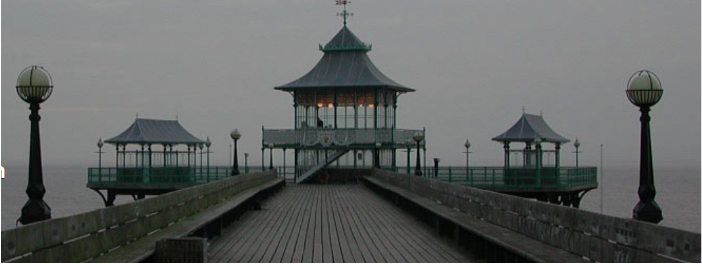
Piers were originally built as landing stages for passenger boats, and were usually made of timber and either cast or wrought iron. The first pier was Ryde on the Isle of Wight, built in 1814, and in their heyday there were 100 piers around our coastline, but only half survive today and several of these face an uncertain future.
The five piers in Somerset are at Minehead, Burnham on Sea, Clevedon, Weston-super-Mare and Birnbeck, and have all suffered various fates.
Minehead Pier opened in 1901, where steamers were called on a regular basis. Unfortunately, it was removed during WW2 in order to allow nearby gun batteries a clear line of sight.
The pier at Weston super Mare first opened in 1904 and has had a chequered history, having twice been destroyed by fire (1930 and 2008).
The Grand Pier re-opened in 2010 and soon became one of the UK’s premier attractions, not only for visitors but also TV production companies looking to film there.
Birnbeck Pier, also known as the ‘Old Pier’, is the only pier in the country to link the mainland to an island, and opened in 1867 with a local public holiday, following a failed plan in 1845 to build a suspension bridge.
The pier closed to the public in 1994, with the lifeboat moving off in 2011. Part of it collapsed during storms in 2015 and it is currently on the English Heritage At Risk register.
Various plans to obtain grants to restore it so that the lifeboat can return have been unsuccessful and in the meantime storms continue to batter the pier.
The next FOTMOS meeting will be held via Zoom on Tuesday, January 20, at 7.30pm, when Jonathan Holt will give a talk on Somerset Follies.
Before that, on Saturday, December 6, from 7.30pm to 9.30pm, FOTMOS is presenting the West Somerset Brass Band in the Great Hall at the Museum of Somerset for an evening of festive music with seasonal favourites.
During the interval, a glass of hot cider or apple juice is included with the ticket price of £12.50.
Comments
This article has no comments yet. Be the first to leave a comment.