

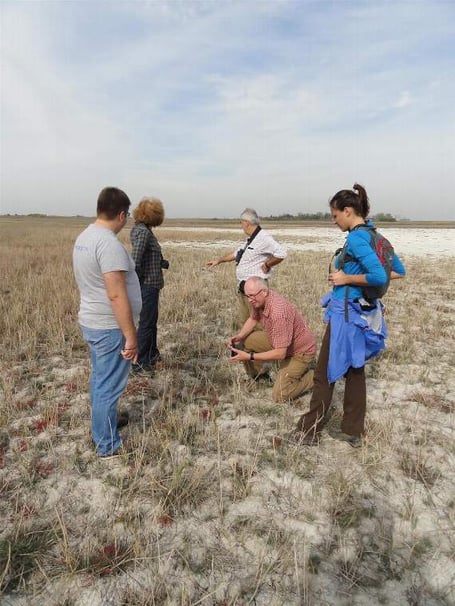
conservationists Gwil Wren and Trevor Phelps, from Milverton, have recently returned from a trip to Serbia where they visited nature reserves and discussed their management with local professionals.
Gwil is a director of a not for profit company EuCAN (European Conservation Action Network) which organises wildlife and working holidays to little known areas of Europe. He and Trevor run the EuCAN Milverton Conservation Volunteers, one of several groups that operate under the EuCAN umbrella.
They were invited to Serbia by the Institute for Nature Conservation in Novi Sad to explore the northern Province of Vojvodina, discuss how nature conservation was practised and look at opportunities for UK groups to visit.
They visited five nature reserves including steppe grasslands, salt lakes, wetlands, woodlands and a 22km long Roman earthwork.



The biodiversity is very rich and important in European terms, one of the salt lakes is home to more than 15,000 wintering cranes, the Roman earthwork has a grass sward that has been largely unchanged for nearly 1800 years and the surviving steppe grasslands are completely natural having gradually established as the ancient Pannonian Sea dried more than 12,000 years ago.
Wildlife in Serbia is facing similar challenges to wildlife in the UK and elsewhere in Europe such as climate change, habitat loss and fragmentation, and the impact of intensive agriculture. But the institute, in partnership with local protected area managers, is making strenuous efforts to restore habitats, link sites with wildlife corridors and manage them in a sustainable way.
In one community more than 300 farmers are collaboratively grazing their dairy cows on the communal pasture attached to the village.
Although it is a protected area it needs grazing and these extensive pastures produce top quality milk.
The project also co-ordinates collection and marketing with the milk being sold to local dairies at a premium price to the benefit of all.
In another area they saw habitat restoration to support the last pair of Imperial Eagles in Serbia.
Gwil and Trevor are keen that these efforts are supported and feel considerable potential exists for holidays in the area. Gwil said: “We were honoured to be invited by the institute, which showed us some fantastic wildlife sites.
“Serbia is an incredibly interesting and varied country and we are hopeful that we will be able to return with holiday groups either to undertake voluntary work on some of these sites or just to experience the fantastic wildlife and culture that Serbia and Vojvodina have to offer.”
ANYONE interested in visiting Serbia and its wildlife or undertaking conservation volunteering in the area can call Gwil on 01823 400657.
Comments
This article has no comments yet. Be the first to leave a comment.