

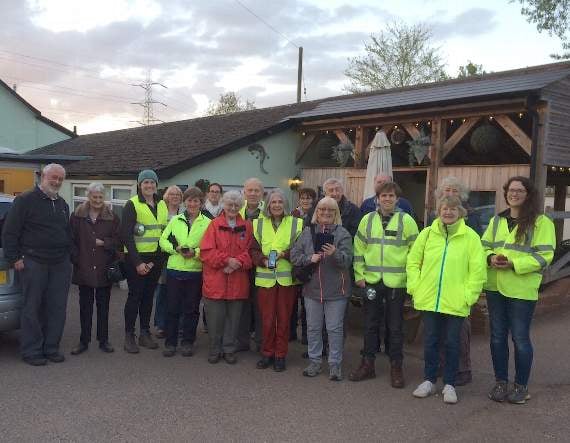
ONLY very young children can hear the echo-location sounds that bats make to navigate obstacles and find their prey, but on May 10 members had a chance to share this experience through the magic of technology, using bat detectors.
Members met at the Holywell Inn, many arriving early to enjoy a meal together, and they were joined by Hannah Maben from Seasons Ecology and her colleagues Ali and Dan for a Bat Talk and Walk.
Hannah introduced members to the range of bat species in the England and revealed that Somerset is famous for having 16 species resident. She told
members about the roosting habits of bats and the legal protection they enjoy, and explained how to look for signs of a roost inside buildings, including piles of moth wings. All bats in this country are insectivorous and the Pipistrelle, our most common bat, can eat an amazing 3,000 midges a night.




Members then walked in the dusk with the bat detectors. These pick up the echo-location pulses bats emit and convert them to a form adults can hear. Each species emits pulses on a different frequency, so the detector not only tells whoever is holding it a bat is nearby but also what species it is.
Members soon heard the first ‘clicks’ from the detectors and as many as five Pipistrelles were flying down the lane beneath the trees, through a gap and back up the other side of the hedge. All this at speeds which made it impossible to see any details in the fading light.
Members thank Hannah, Ali and Dan for a glimpse into the life of these fascinating animals.
The group’s next get-together is on June 14 when members will visit Kia Ora Farm and Gardens, Cullompton. Places are still available – anyone who would like to go along should phone Debbie on 01823 662957.
Comments
This article has no comments yet. Be the first to leave a comment.