

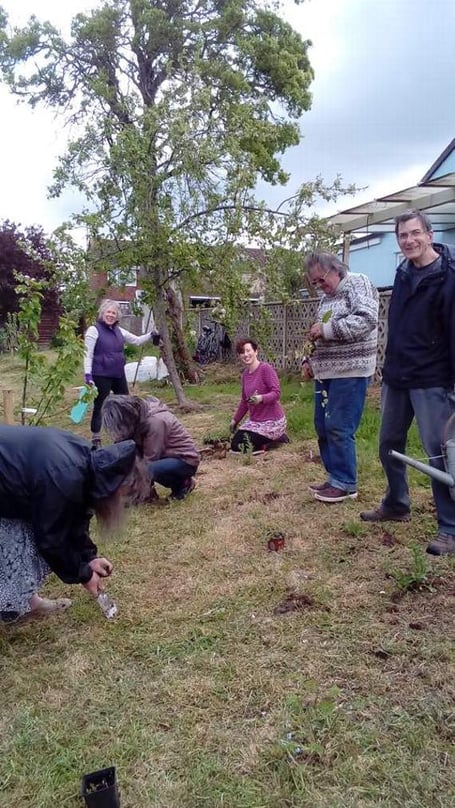
THE small strip of land that connects Post Close and Monument Close is being transformed from a nondescript grass verge full of brambles and nettles to a bustling, busy flower-rich meadow for bees and butterflies.
Environmental group Transition Town Wellington persuaded the town council to ‘adopt’ the land on its behalf from the Highways Agency and back in December the group planted fruit trees to create a small community orchard – like others it has established and is looking after at Swains Lane, Bulford Road, Dobree Park and the Basins. Rather than leave the ground beneath the trees as uninterrupted grass, members decided to add dozens of pollinator-friendly plants to enhance biodiversity.
“The fall in the population of pollinators – bees, hoverflies, butterflies, moths and other insects – in the UK has been horrendous,” said Helen Gillingham, who is spearheading the campaign to restore habitats for the creatures. “By planting up otherwise barren verges and plots around our town, we can really help to combat this.”
Last year, Somerset County Council issued a ten-year Pollinator Action Plan. It aims to reduce the amount of roadside verge cutting and minimise or entirely stop using harmful pesticides and herbicides. The plan states the aim is to: “Protect, increase and enhance the amount of pollinator habitat in Somerset to prevent extinctions and improve the status of any locally threatened species.”



Volunteers in Wellington spent a Saturday morning planting the many seedlings and plug plants that had been donated. The grass is now dotted with oxeye daisies, white deadnettle, yellow rattle, meadowsweet, herb robert, fox-and-cub (orange hawkweed), lemon balm, bistort, bladder campion, and lesser bird’s-foot trefoil, among others.
To prevent the too frequent mowing of the new meadow, the group put up signs saying that the ground was being left deliberately ‘wild’ to create a healthy habitat for pollinators.
Di Hall, whose house and garden are next to the site, was full of praise for the scheme. She said: “It’s not just a sign for the council workers, I’ve seen lots of children stop and read it – it’s educating them about the environment, too. That’s so important.”
More and more people are seeing the value of leaving their gardens a bit wild and the green spaces around town not so neat. TTW’s Andi Rickard said: “Messy is good, as far as wildlife is concerned. It is one of the indicators of a healthy, bio-diverse landscape – which is what all species need – including humans!” CONTRIBUTED
Comments
This article has no comments yet. Be the first to leave a comment.