

THE meaning of ‘fix’, to repair something, dates back only about 300 years, but I like the earlier use of the term: “To set [one’s eyes or mind] on something.” Last summer, Trisha Comrie, of the Blackdown Hills Transition Group, set her mind on something amazing – to put together an event for local people to get things fixed free of charge. She then set about making her vision a reality – and months of hard work paid off at the group’s first ever Repair Café’ at Hemyock village hall.
The place was buzzing with activity, as people flocked in with broken bikes and torn clothes, old chairs and dead computers. With more than 20 skilled ‘fixers’ on hand, a busy tea and cake stall, and so many people and their stuff, it exceeded Trisha’s wildest expectations, she said.
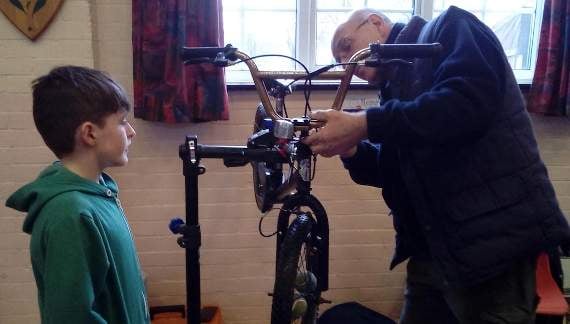
At the bike repair station, one young lad’s cycle was up on a stand. He watched, fascinated, as Ian Lee-White, one of the local ‘fixers’, stripped out a rusty cable and replaced worn brake pads on his bike. A former design engineer, Ian retired to Hemyock three years ago, but has put his years of experience to use, setting up his own successful cycle repair company in the village.
A stitch in time saves nine, they say, and Susan Risdon or ‘Sewing Sue’ as she’s known, made short work of turning up the hems on a pair of bright red trousers. The trousers belonged to Jude Dimuantes, a dynamic woman who set up a repair café in Exeter. It takes place in St Sidwells on the third Saturday of every month and is going from strength to strength. She’s delighted to see the idea spreading – and even more delighted with her trousers, which now fit perfectly!


At the next table, Mary Pepper watched anxiously as Jon Snow, the local blacksmith, delicately fixed the leg of a porcelain bull back on its stump. The bull was a 21st birthday present from Mary’s favourite aunt. “My son had made a football out of newspaper and Sellotape, and he was kicking it about,” she said. “His slipper flew off and knocked this poor bull off the shelf!” After a gap of nearly 40 years, the bull has been finally reunited with its missing limb and stood there proudly, as good as new.
A queue formed at David Ball’s table. He specialises in restoring antique furniture and explained the advantages of having rubber pads on the clamp as he glued back the leg of an old wooden chair. Long-time Blackdown resident Stephan Lehner had brought the old chair in in a sorry state, but rather than throwing it out, he’d brought it along to see what could be done. “It’s lovely to see so many people here,” said David as he worked. “We could have been sitting here having tea and cake – but it’s been non-stop all morning.” Putting the clamped chair to one side, he turned next to the beautiful old carved box that Val Mister had brought it. Val, a keen member of Wellington’s own Transition Town group, is keen to see a repair café in Wellington. “It’s not just about getting things mended, it’s about sharing skills and knowledge,” she said.
If it ain’t broke, don’t fix it as the saying goes. But what about if it is ‘broke’? In today’s throwaway culture, we’re encouraged to chuck it out and buy a new one. But growing concerns over overflowing landfills, plastic waste and the realisation that we have reached what some call ‘peak stuff’ is galvanising local communities into action. The first repair café was set up in Holland in 2009 by Martine Postma and more than 1,400 are now in existence across the world. If the success of Hemyock’s repair café is anything to go by, this is just the start. If you’re interested in joining the ‘repair revolution’, check out www.repaircafe.org/en and join the Transition Town Wellington group to build a better, more sustainable future.
ANITA ROY
Transition Town Wellington
Comments
This article has no comments yet. Be the first to leave a comment.