

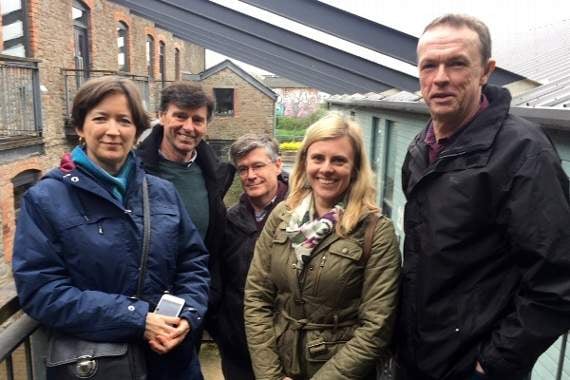
MEMBERS of Wellington Mills Community Interest Company have been on a fact-finding visit to a once derelict factory site in central Bristol.
They wanted to find out how the Paintworks site had been transformed into a vibrant urban village over the last decade and a half and what lessons that might have for Tonedale Mill.
Verve Properties, owned by surveyor-turned-developer Ashley Nicholson, bought the 12-acre site in 2003.
He said: “Paintworks is a piece of the town, not a development. It’s a place where people want to work and where people want to live. Not all that complicated really, but not many places are like it.”

.jpeg?width=209&height=140&crop=209:145,smart&quality=75)
-Rachel-Gilmour-MP-Gideon-Amos-MP-Ashley-F.jpeg?width=209&height=140&crop=209:145,smart&quality=75)

In the early phases the brick buildings where Courtaulds once made paint were split up into small office units aimed at businesses with ten-15 staff. Some were leased, some sold to provide cashflow.
“Our previous experiences in London and elsewhere told us that these were the companies that had flexibility and weren’t too status conscious,” Ashley said. Some of those early occupiers have grown and thrived but are still on site.
The establishment of a café-bar called Bocabar was also critical in the early days and is still the social and hospitality hub of Paintworks.
“Early on we provided some space for a student art show,” Ashley said. “Seven-hundred people turned up. We had one loo and a tiny bar but it was a fantastic event talked about for months.” A busy event space still exists beneath the Bocabar, often used for weddings as well as gigs and exhibitions.
In later years major developer Crest Nicholson worked on the eastern third of the Paintworks site, creating a complex of flats and offices. “A company its size worked at a scale and speed that would have taken us many more years to achieve,” Ashley said.
CIC director Ben Fox said: “Ashley’s achievement at Paintworks is inspirational for us and really shows the potential of Tonedale if we’re able to bring the right combination of people and businesses on to the site.”
The visit to Paintworks and to the Red Brick Building in Glastonbury later the same day was part of an ongoing research programme part-funded by a grant from Wellington Town Council.
Comments
This article has no comments yet. Be the first to leave a comment.