
THIS month, Transition Town Wellington are comparing what was thought about shopping back in 2010 in the local “Towards a Resilient Wellington” report to our reality today.
The imaginary future shopping world of Wellington back in 2010 focuses on buying locally and for goods to last, it mentions a disappearance of the plastic bag, which has thankfully more or less come true with the introduction of the charge in 2015.
Unfortunately, much of our fruit and veg in supermarkets is still packaged in plastic, the reason given it increases shelf life and protects fruit and veg from damage, supposedly reducing food waste; although often you are forced into buying more that you might need meaning you may just throw it away at home.
Wellington lost its independent greengrocers a year or two ago and we no longer have a regular veg stall at the local market which has resulted in most people buying from supermarkets.



An alternative is the newly set up community farm “Wellington Community Food” who will be opening their veg box shares for 2026 soon with nothing packed in plastic.
Perhaps the wonderful idea in the report of surplus veg being brought to a “Community Bartering Centre” might be something that could be developed?
The UK is still falling woefully short of producing anywhere near the food it needs. The fact of food coming long distance is still continuing with perhaps lorries being powered by electric rather than fossil fuel in the future.
The reduction in food miles needs to be urgently addressed if we are to reach net zero.
Eating more local food and a change to the heavy reliance on fossil fuels for agriculture are needed to do this.
Since 2010 there has been a backlash against fast fashion and a real rise in recycling and selling unwanted clothes.
Social media and websites such as Vinted (begun 2008) and Etsy (2006) have made this much more possible than anyone could imagine in 2010 when only about a quarter of us in the UK used smartphones and the main selling platform was eBay; wearing second hand clothes has certainly become fashionable.
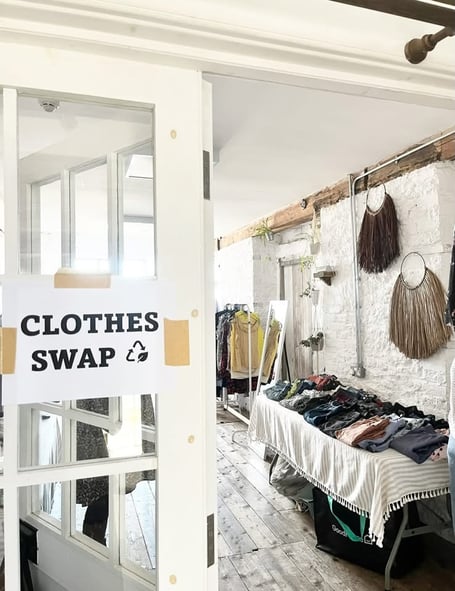
We have two regular clothes swaps in Wellington; one aimed at the zero to five age bracket held on the second and fourth Tuesdays of each month at the Methodist Church, and a quarterly adult clothes swap at Pure Yoga Somerset organised by the team at “Slow and Circular”.
The report talks about how mending and repairing have become vital skills and it is certainly more popular now with the growth of Repair Cafés and sewing bees around the country.
Repair Cafés were originally a Dutch idea and started in 2009, we now have a regular bi-monthly one in Wellington, with many other local towns having them too.
Unfortunately, much of the progress hoped for back in 2010 with goods being built to last and much more local produce and local manufacturing has not come about. Our shopping world is still very much a global one based on fossil fuel.
Comments
We've recently changed our login process. If you have an account for commenting, you will need to re-register on the login window.
This article has no comments yet. Be the first to leave a comment.