

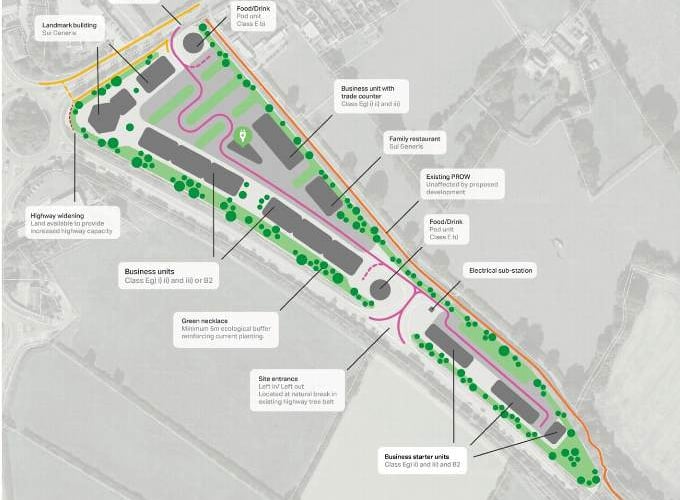
PLANS have been submitted for a new £35 million business park serving Wellington which could create more than 200 full-time jobs.
The estate, named Chelston Heath, would be on a wedge of green fields at Chelston and outside the town’s development boundaries.
But the agent for the development, Tetra Tech planning director Simon Coles, said it was no different to nearby Westpark 26, Chelston Business Park and Foxmoor Business Park.
Each was also outside the settlement boundary and in open countryside but the former Deane council still granted planning permissions for the developments and their expansion/intensification over time.

.jpeg?width=209&height=140&crop=209:145,smart&quality=75)
Chelston Heath was the triangle of land at Chelston roundabout between the M5 spur road and the A38 to Taunton.
Plans for a Lidl supermarket, family restaurant and coffee shop development for the site were mooted two years ago but fell through.
Mr Coles said using the 9.4-acre Chelston Heath site would help the district council meet an identified need for up to 130 acres of employment land over the next 18 years.
He said Wellington was the district council’s preferred sustainable location after Taunton for new housing and jobs until 2040.
New jobs at Chelston Heath would help to match new housing in Wellington and the surrounding area, and the town’s self-containment, reducing the need for residents to travel to Taunton for work.
Mr Coles said a significant number of new homes were under construction locally including at Longforth Farm, Jurston Farm and Bagley Road in Wellington, and Comeytrowe, in Taunton, totalling 3,400 properties and associated uses.
He said: “This is a need arising now and a response is required in order to keep pace with new housing development in Wellington and at Comeytrowe.”
Chelston Heath would have a high quality ‘park’ design envisaged to address ecology and climate emergencies declared by both the district and county councils.
Including construction investment, the development was estimated to create a near-£100 million boost to the local and national economy.
The indicative masterplan for the development included starter business units in modules of 1,000 sq ft, a total of 42,000 sq ft of general industrial and office uses, two food and drink restaurant kiosks and one restaurant each up to 2,500 sq ft, a 7,500 sq ft business unit with ancillary trade counter and some unspecified uses covering nearly 14,000 sq ft.
Chelston Heath was forecast to generate about 236 full-time equivalent jobs which were likely to appeal most to local people. Many roles could be part-time, which would increase the actual number of new jobs.
This was on top of the jobs which would be safeguarded or created during construction and in the local supply chain.
Mr Coles said design of the business units would be modern and high quality but functional, using low carbon materials and maximising passive solar gain.
Buildings would be provided with electric vehicle charging infrastructure for employees and visitors, and the use of public transport and active travel such as walking and cycling would be promoted.
The opportunity also existed for the scheme to provide land to improve Chelston roundabout subject to discussions with the county and district councils.
The district council planning department is currently consulting publicly on the application until January 28 and has until April 7 to determine it.
Comments
This article has no comments yet. Be the first to leave a comment.