
Wivey has jazz February session success
THE sound of classic jazz from the 20s through to 40s swing, with tunes such as Ain't Misbehavin', Hello Dolly, The Lady Is A Tramp, Dinah, Tea For Two and On The Sunny Side Of The Street, rang out from The Jubilee Hall in Langford Budville at the February session of Wivey Has Jazz.
Enhanced by its wonderful acoustics, the audience of jazzers were delighted to listen to Zoe Lambeth's Vintage Jazz Collective.
This five-piece has Zoe on reeds and vocals, Steve Dow on guitar and vocals, Martin Jenkins on piano, Jim Rintoul, double bass and Gary Evans, drums.

The dancers in the audience had plenty of exercise.
The next session is on March 11.
Ron King's New Riverside Jazz Band will be playing New Orleans style.
This is a traditional line-up with trumpet/harmonica, reeds, trombone, sousaphone, banjo/guitar and drums.
The music starts at 7.30 pm
Entrance is £15, cash only, payable at the door.
For further information, email: [email protected] or [email protected]
Friends of The Museum of Somerset hear about Hadrian’s Wall
FOLLOWING a brief AGM, the Friends of The Museum of Somerset (FOTMOS) were pleased to welcome to their February Zoom meeting Sean Pringle Kosikowsky, the site manager at the museum, to talk about his recent walk along Hadrian’s Wall.
Following the Roman invasion in 43AD, a stone road (Stanegate) was built in northern England linking the forts that guarded important river crossings.
In 122AD Hadrian’s Wall was built closely following this route. It is 73 miles long and runs from Wallsend to Bowness on Solway.
Sean decided to walk east to west as it fitted in with the coach timetable.
Unfortunately this was against the prevailing winds (making him regret he had decided to walk in shorts rather than trousers) and he met few fellow walkers going that way.
Sean reported that the views could be spectacular.
Walking gave him great opportunities to observe the construction of the wall - there are two ditches, one V shaped on the north side for defence, the other a vallum, marking the southern boundary of the military zone.
Sean’s first encounter with the actual wall came some 27 miles into his walk at Planetrees.
The wall was originally planned to be 10 feet wide, but obviously the Romans decided this was taking too long to build so it was reduced to six feet.
The change in plan must have come after the foundations had been laid for the wider wall, and these can still be seen to this day.
Because the wall was built using local stone, the materials and colour change as it progresses.
Moreover, inevitably the wall falls under different councils across the country, so different rules apply to different sections.
Sean came across the Temple to Mithras at Carrawburgh.
This was one of the religions practised by Roman soldiers.
When Sean reached the now notorious Sycamore Gap, he was pleased to see that the original tree was sending out new shoots, despite the vandalism perpetrated there.
Reflecting on his walk, Sean decided he had taken too much in his backpack, which had given him sore ankles.
However, although he had found it arduous, he would definitely be happy to repeat it or something similar.
Moreover, he had reached his charity fund-raising goal.
The next FOTMOS meeting will be held via Zoom on Tuesday, March 17, at 7.30 pm, when Amy Downes will talk about ‘The Snailman of Pontefract’.
Tickets are selling quickly for the FOTMOS Annual Lecture (At the Edge of the World) which will be held on Tuesday, April 14, at 7.30 pm at the museum.
Professor Danielle Shreve will explore the impact of climate change on wildlife in southwestern Britain over the last 100,000 years.
If anyone would like to join, email [email protected]
Wellington and District Townswomen’s Guild February meeting
THE intriguing world of philately, or stamp-collecting, was revealed to members of Wellington & District Townswomen’s Guild when they gathered for their monthly meeting at Lodge Close Hall on Monday, February 9.
Peter Hardie, chair of the Taunton branch of the Bridgwater Philatelic Society, Wellington resident and former stamp auctioneer, told us how he caught the stamp bug from his mother, who had a big box of stamps from all over the world. As a child he was fascinated by them and would look through them frequently. This resulted in a life-long interest in stamps, and, as a by-product, also taught him about world geography and history.
Although the Royal Mail was founded by Charles I in 1635, the fee for postage was paid by the recipient, and was too costly for many people’s pockets. It was only when Rowland Hill introduced the far more affordable Penny Post in 1840, with the fee paid by the sender, that postage stamps as we know them arrived. Just one penny would get a letter sent to anywhere in Britain.
Philatelists are seemingly as varied as the stamps themselves: some concentrate on very narrow genres, such as stamps featuring birds or flowers, or from the reign of a particular ruler, while others focus on postmarks from certain places, ‘covers’ showing the address, or specific international delivery routes.
The hobby of philately can develop into an expensive obsession, with some stamps being highly sought-after and changing hands for many thousands of pounds. Others, however, particularly more modern issues, are not very valuable but are still collected by many, making for a more affordable hobby.
Peter’s profound knowledge of his subject made for a very interesting talk, and afterwards members pored over the many examples of stamps, covers and other items which he had brought with him.
The raffle and refreshments followed, and then it was time for the business part of the meeting. The minutes of the last meeting were read and approved, and the annual membership fee for the coming year was discussed.
The next meeting will be held at Lodge Close Hall at 2.30 p.m on Monday, March 9.
Coffee morning raises more than £300
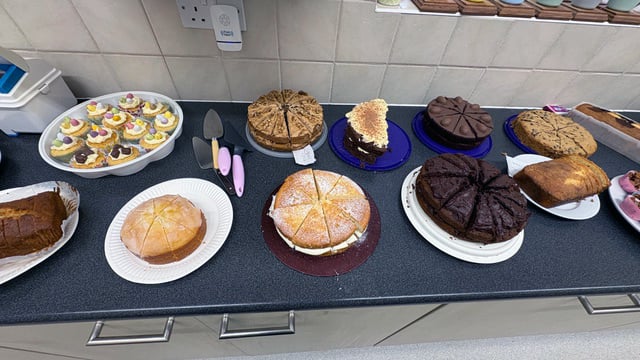
A COFFEE morning in aid of the Beacon Centre, Musgrove Park Hospital, Taunton, was held at Wellington Bowling Club.
The Beacon Centre is the club president’s chosen charity and the coffee morning raised £310.
This brought the total raised by the bowling club to almost £2,000.
A wide variety of cakes and biscuits were provided by club members and teas and coffees were available for everybody.
There were lots of donated prizes for the raffle and a ‘guess the weight of the cake’ competition.
Guessing the weight of the cake was popular, although some people found it difficult because the weight was in grams.
Despite this, club member Sue Perry was the winner.
She guessed that the cake weighed 1,279 grams and was just one gram away because it actually weighed 1,278 grams.
Everybody who went along enjoyed the event and generously supported the Beacon Centre at Musgrove Park Hospital.
Residents enjoy sound bath
ON Monday, March 2, house manager of Abbeyfields Ivy House, Alisha Cordy organised for Anita-Maria to showcase her singing bowls in their communal lounge.
Around 12 residents up to the age of 99 enjoyed the 'sound bath', a handful fell asleep and the other residents commented how relaxed they felt.
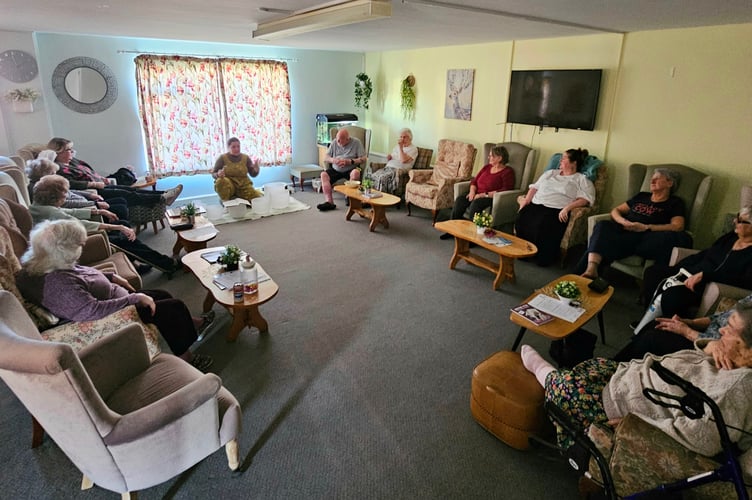
Alisha said: “It was nice for them to try out a brand new experience. We hope to welcome back Anita for another sound healing session soon.”
Rotary club announces spring with a glorious display
SINCE 2020, Monument Rotary Club's members have been planting thousands of purple crocuses around Wellington.
This is part of a campaign to make people aware of a worldwide fight against polio disease.
Rotary International has been fighting to eradicate polio for over thirty years, and together with partner organisations have reduced the incidence worldwide by over 99 per cent.
In 1988, there were an estimated 350,000 cases in more than 125 endemic countries.
This has reduced to six reported cases in 2021.
Of the three strains of wild poliovirus (type one, type two and type three), wild poliovirus type two was eradicated in 1999 and wild poliovirus type three was eradicated in 2020.
As of 2022, endemic wild poliovirus type one remains in Pakistan and Afghanistan.
Thousands of children and young adults were paralysed by the disease before then, permanently losing the use of one or more limbs, and sometimes losing their lives.
Each child who has been vaccinated, has their finger marked with purple dye which wears off after a few days.
The purple fingers of the millions of treated children inspired the idea of planting purple crocuses to celebrate this achievement.
Funded by members, Rotary groups around the world have been buying and planting purple crocuses corms to brighten up the early Spring in the communities where they live and work.
Check out Roly Poly Green, outside the site of the old Luson Surgery, and on the small Green near Beech Hill Stores.
Read more here: polioeradication.org
Comments
This article has no comments yet. Be the first to leave a comment.