
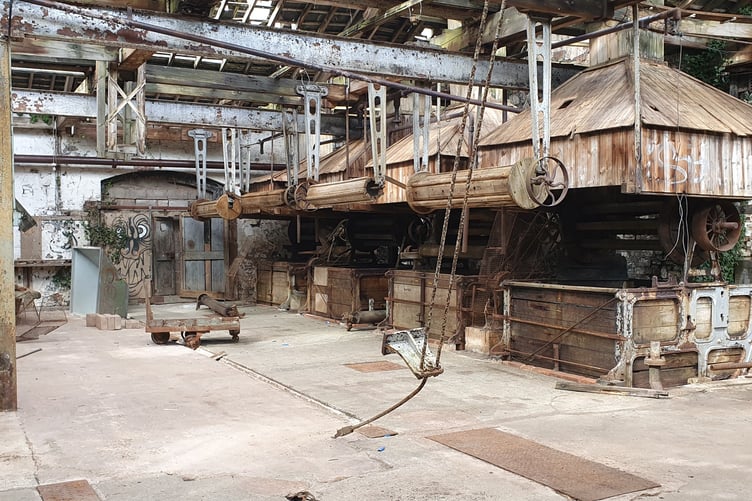
COUNCILLORS have agreed to spend £50,000 on supporting ongoing works to refurbish the historic Toneworks site in Wellington. Members of Wellington Town Council’s policy and resources committee met last month where they discussed a request for financial help to fund extensive works being carried out by the Somerset West and Taunton Council to protect and repair the Toneworks site.
Councillors recommended that £50,000 be made available for the project and this was verified by the full council when it held its monthly meeting on Monday (March 6). But prior to the meeting a member of the public, former town councillor Dave Mitton, questioned whether it was sensible to support such a scheme with such a large amount of money with the Toneworks not actually being within the parish of Wellington, but in neighbouring Langford Budville.
Toneworks was the cloth-finishing works of Fox Brothers, one of the oldest and largest woollen textile manufacturers in the South-West of England. It is a rare example of a textile finishing works retaining all its textile working machinery.
Cloth production ceased in the late 20th Century and Toneworks finally closed in July 2000. Since then it has been placed on Historic England’s Heritage at Risk Register.
 Protect Wellington group declares opposition to Pegasus countryside housing proposal
 Warning issued for whole of Christmas Day as strong winds set to hit Westcountry
 Wellington man dies in hospital 13 days after woman's attempted murder arrest
 Wellington among three fire crews working to free horse trapped in farm slurry pit
But Somerset West and Taunton Council has been working towards preserving the site and bringing the buildings back into life with commercial, cultural and creative uses.
The site has become recognised by Historic England as “nationally significant” and has ploughed nearly £1m into the project in grant support.
Representatives of Somerset West and Taunton Council attended Wellington council’s policy and resources committee and outlined that funding was needed to cover some works that were not included in the Historic England’s financial package. A council report showed a “shopping list” of items with a total of more than £100,000-plus.
Cllr Marcus Barr said: “We had a good discussion about this at our policy and resources committee and I was originally sat on the fence, but I think providing £50,000 is a small step for us to say thank you to the Somerset West and Taunton Council.
“Instead of spending money on buying the Green Corridor land which we’ve now taken over, the Somerset West and Taunton Council could have used that money on this project.
“I propose that we do this as this project is part of Wellington.”
The council accepted that “technically” the Toneworks were within the parish of Langford Budville, but said that bringing the site back into use would have benefits for Wellington.
Town clerk Dave Farrow said he had spoken to the parish clerk at Langford Budville and that the parish council would be looking at the project.
And he added: “The benefits of this will be felt by Wellington.”
Cllr Andrew Govier said: “This is an internationally historic site and the building and machines are unique to not only this country but possibly Europe.
“There is momentum building for this project going on down there. If we don’t support this, the project could be mothballed.
“Technically the site is in Langford Budville, but it’s part of Wellington’s history and this will benefit the town’s economy.”
Cllr Keith Wheatley said: “I was delighted when it was agreed we would bridge a funding gap. We are helping to bring these building back into use.
“There is a lot of interest pending and building up for future uses of the Toneworks.”
Cllr Chris Booth said: “This will be fantastic for Wellington – let’s go forward.”
Cllr Ross Henley said: “So much work has been done by so many people to get it to this stage. It’s important that we back this project. It’s the start of something really exciting happening down there.
“The greater area of Wellington will benefit – a wonderful project for the community.”
The £50,000 will come from the council’s Community Infrastructure Levy pot which has around £500,000 sat in its budget. CIL, as it is known, is a charge that local authorities can set on new developments in order to raise funds to help fund infrastructure, facilities and services needed to support new homes and businesses.
Comments
This article has no comments yet. Be the first to leave a comment.