
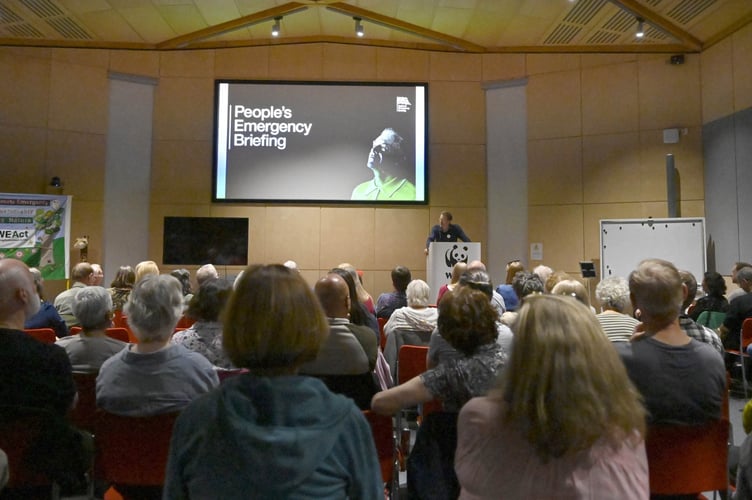
FUTURE farming generations in West Somerset won't have viable land to grow crops on if we continue to burn fossil fuel at current levels.
That was the warning from Exeter University climate scientist Tim Lenton in the People's Emergency Briefing on climate and nature loss screened in Langford Budville on Friday, May 22.
Professor Lenton, a world authority on climate tipping points, said an ocean current called the Atlantic Meridional Overturning Circulation (AMOC) keeps the UK climate mild but it is weakening.
“An AMOC tipping point would transform the UK into an unrecognisable place, with winters of -20°C in London and -30°C in Edinburgh, and hotter summers and lower rainfall. This would end large-scale agriculture in the UK,” he added.
 Dorset and Somerset Air Ambulance challenge for World Cup football fans
 Teenagers in crown court three years after alleged Wellington stabbing
 Work starts on Wellington Aldi supermarket with completion due sooner than thought
 Shoplifter told to attend drug rehabilitation while jail sentence is suspended
Three days after the screening, Wellington recorded its highest ever May Bank Holiday temperature at 31.3°C, only to be eclipsed a day later on the May 26 by 33.4°C.
Local weather expert Simon Ratsey pointed out the average highest temperature recorded for May in the Wellington area during the 1960s and 1970s was more than 10°C cooler.
The screening at Langford Budville's Jubilee Hall attracted a mixed audience with organiser Josh Wedderkopp inspired by the discussions held afterwards, as so many people had shown an appetite to take action. “Now our challenge is to work as a community to create this positive change and to support each other,” he said.
Similar screenings are taking place throughout the UK in an effort to urge MPs to join the call to broadcast an emergency briefing on national television.
So far 77 MPs, including Gideon Amos, MP for Wellington, and 21 Peers have joined the call for the government to act.
The next local scheduled screening is West Somerset of the People's Emergency Briefing at Wiveliscombe Town Hall on Thursday, July 9, from 7pm.
Comments
We've recently changed our login process. If you have an account for commenting, you will need to re-register on the login window.
This article has no comments yet. Be the first to leave a comment.