

Mind-bogglingly frustrating council spending
Dear Editor,
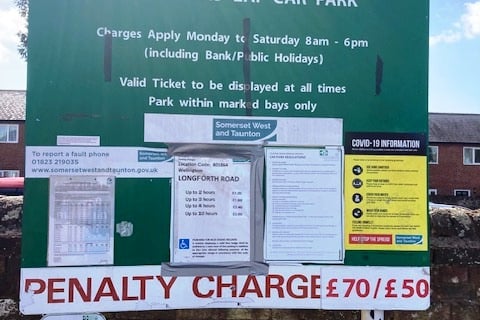
The news from a near-bankrupt Somerset Council that it plans to spend £272,854 on finding out the public's views on how public car park charges should be set is mind-bogglingly frustrating to this councillor.
Wellington's three town centre car parks are pretty much a disgrace. The white lines marking the bays have often almost faded to nothing leaving a kind of parking anarchy. Some machines will not take card payments, only coins - remember those? And the signage is a mixture of outdated charges and long forgotten COVID distancing reminders.
.JPG?width=209&height=140&crop=209:145,smart&quality=75)

On behalf of the town council I have been in regular dialogue with Somerset Council officers about these matters and achieved precisely nothing. Last summer they told us that new signage was being prepared and that quotes for design and supply were being sought. By December nothing had changed in that respect, "the procurement process was still ongoing".
The town council cautiously explored the option of producing and paying for new signs ourselves. Absolutely forbidden! So the saga of incompetence and delay drags on, as our car parks continue to deteriorate. But do take part in the survey, when it arrives.
Yours sincerely,
Cllr Keith Wheatley
(Wellington South East)
Interested in starting a Wellington Peace Group
Dear Editor,
We live in an increasingly divided world where violence is often seen as the way to resolve disputes. In the last weeks the tension in the Middle East has exploded – an inherently volatile situation has been exacerbated led by an unstable US President who had renamed the Department of Defence [sic] the Department of War.
Peace starts at a local level and as a Quaker we believe that peace making is close to the heart of all of us. Many in Wellington value the peace garden at Wellington Quaker Meeting House as a quit place for reflection. Taunton Quakers hold a regular monthly vigil in Taunton town centre. But many from all backgrounds are alarmed by the hostility towards different groups and the scale of potential damage done by wars, both to human life and wellbeing and indeed to the planet.
On the recent escalation in the Middle East Quakers in Britain urged the government "to reverse its decision to support bombing, even in a defensive way, and say that stability and security are achieved through dialogue, diplomacy and careful long-term peace making, not through threats or weapons, which bring destruction, peace and death".
Is there interest in our town for a Peace Group open to all? If so I would be pleased to convene an initial informal meeting, both to share thoughts and feelings and to consider possible actions.
My email is [email protected]
John Ainsworth
Dukes Court, Wellington
Train travel concerns for those with sight loss
Dear Editor,
Rail travel is key to getting around for blind and partially sighted people yet remains and unsafe for many with sight loss.
RNIB research shows barriers exist at every step of the journey: planning, buying and managing tickets, navigating in train stations, finding staff, getting on the train safely, finding a seat, and more. Think about having to judge the gap between the train and the platform without being able to see it clearly.
It doesn’t have to be this way. Operators can play their part by training their staff on how to support passengers better and make sure tactile wayfinding or better signage is introduced to make it possible to navigate more independently around stations.
Fellow passengers can make a massive difference too. From choosing to offer a priority seat or help someone safely across the gap, passengers can turn a difficult journey into an easier one. These are the small everyday actions many people already take, and when more of us do them, it can be the difference between someone travelling with confidence or deciding not to travel at all.
Eleanor Thompson,
Director of policy campaigns and social action, RNIB (Royal National Institute of Blind People)
Urgent appeal for those in crisis
Dear Editor,
At the international disaster relief charity ShelterBox, we’ve launched an urgent appeal to raise £50,000 to support families caught up in crises in places like Somalia, Sudan, and Ethiopia.
ShelterBox works closely with women to understand what they need and support them with things like securing tenancy agreements and understanding their rights. Their knowledge, leadership, and resilience are vital in rebuilding lives. At every stage, we assess the specific risks they face and provide practical items that help maintain dignity such as private shelters with lockable doors, solar lights, fuel-efficient stoves, reusable sanitary products, and underwear.
Our spring appeal comes at a crucial moment. The need for emergency shelter is rising, while global humanitarian funding is falling. We urgently need support to reach more families.
Kezhe Temir
Programme officer at ShelterBox
Comments
This article has no comments yet. Be the first to leave a comment.