

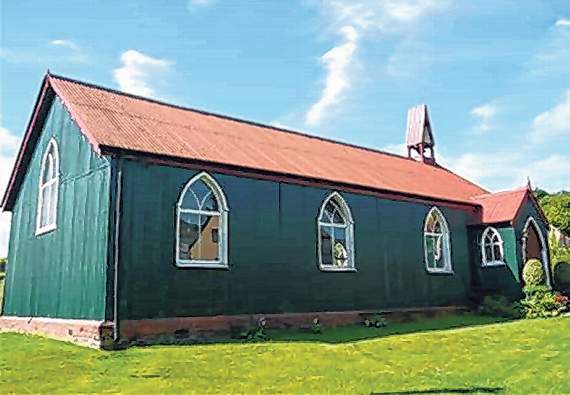
PLANS to bring a water supply to a 125-year-old corrugated iron church in a village near Wiveliscombe are coming closer to fruition.
The On Tap fundraising campaign for St Luke’s Church in Langley Marsh – locally nicknamed Langley Cathedral – is now over three-quarters of the way towards reaching its £4,000 target.
A dedicated local committee has been fundraising tirelessly, so that they can have water and expand the building’s use, enabling it to become even more of a focal point for the whole community to enjoy.
The church was opened in October 1893, with the corrugated iron delivered in sections and erected, at the Rev Howard McCricks’s own expense, on land originally given by the Bouchers of Greenway Farm.

It has been lovingly looked after and its corrugated iron structure, gothic arched windows and pointed bell-cote – triangular roof tower where the bell goes – is set back from the road at the end of a short pathway, overlooking fields and hills that lead into Wiveliscombe.
While church services are held there twice a month, and there is wine for communion, there has never been any water.
“If we want to clean the church or make tea or anything, we have to bring water up the lane in buckets,” said Alison Brigden, secretary of the On Tap committee, which includes members of the local community as well as the church.
“During the last 10 Parishes art exhibition we carried about 40 buckets up to wash the inside – and it was hard work.
“We only need wine for Holy Communion but it’s the community events we struggle with and the lack of water limits what we can do.
“It’s a beautiful, iconic building and we want to expand its use, to have art exhibitions, concerts, talks, somewhere that gives people opportunities to mix and get to know each other, that combats rural isolation.”
Plans for the future also include adapting a side room into a small kitchen and giving the roof some attention – but the committee is concentrating on water first, to make the church viable, she said.
“We are proud of the building and we want to future-proof it, it’s such a fine example,” Alison said.
“We want people to be able to come in and use the church for whatever they want.”
The ‘tin tabernacles’, as they were also called, were popular in the 19th and early 20th centuries, when many churches, chapels and mission halls were designed and made in kit form, used both in Britain and the former colonies.
The most common type were timber-framed, externally clad with galvanised corrugated iron and lined with high quality tongue-and-groove boarding.
Anyone interested in knowing more about the St Luke’s On Tap campaign, can contact Alison on 01984 623338.
Comments
This article has no comments yet. Be the first to leave a comment.