
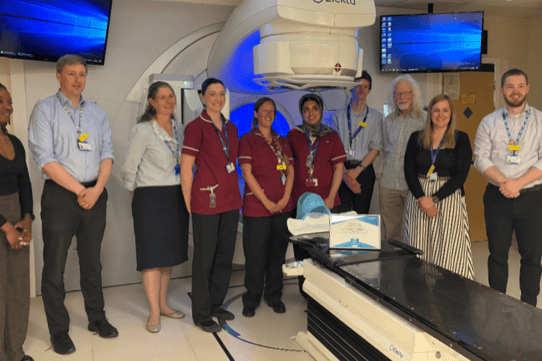
PATIENTS treated in Musgrove Park Hospital for head and neck or breast cancers are now benefiting from state of the art technology during radiotherapy treatment.
The new technology removes the need for tattoos or treatment marks, as well as offering an open mask design, improving comfort during radiotherapy treatment.
Introduced by the radiotherapy, physics and oncology teams at the hospital in January 2024, ‘surface-guided radiotherapy’ marks a significant step forward in improving patient experience and safety while maintaining treatment accuracy.
The system was made possible thanks to a donation of £800,000 from the Somerset Unit for Radiotherapy Equipment charity (SURE), which funded the technology across both pre-treatment and treatment areas.



Since its introduction, the technology has been rolled out across multiple cancer treatment sites, and most recently for patients undergoing radiotherapy to the head, neck and breast regions.
It also allows for the use of an open-face, head-only mask rather than a traditional full-face and shoulders mask, offering a more comfortable experience while maintaining precise positioning throughout treatment.
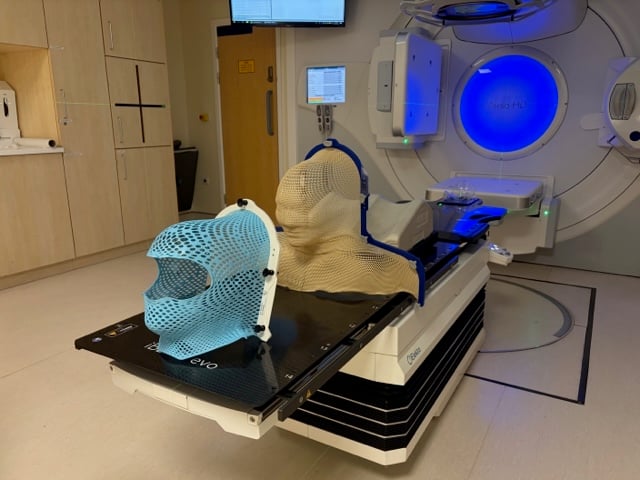
One patient, Johnathon Aylsbury, recently finished six weeks of daily radiotherapy for head and neck cancer and has appreciated the masks making his treatment more comfortable.
Mr Aylsbury said: “The new head and neck support mask was straightforward and easy to use.
“The radiotherapy team had me set up for treatment within four or five minutes, I had my treatment and was in and out very quickly.
“The masks are much better than the previous ones I had seen, which was one less thing to be worried about in an unpleasant time having treatment.
“It was another positive that you do not need to have any tattoos any more as well.”
The surface-guided radiotherapy cameras use infrared technology to track a patient’s body surface in real time.
This means it is possible to continuously monitor a patient’s position during treatment, helping to ensure radiotherapy is delivered accurately and safely while reducing the need for the use of permanent skin markings.
Patients undergoing radiotherapy to the breast also benefit from the system through the use of a breath-hold technique, where the cameras help guide and monitor patients into the correct position, also removing the need for pen marks or radiotherapy tattoos.
A woman patient who has had 15 treatment sessions at the Beacon Centre for breast cancer said: “I am 64, so I was not too bothered about the thought of needing a tattoo, but for other patients I can see how psychologically, it is yet another reminder of the trauma you have been through.
“The whole radiotherapy team, and I met quite a few of them, every one of them was really kind and genuinely concerned and interested in how I was doing and how the treatment was affecting me.
“They made what could have been a very frightening and traumatic experience, as comfortable as possible.”
The developments reflects the ongoing commitment of Musgrove Park Hospital’s radiotherapy team to improving patient comfort while maintaining the highest standards of precision and care.
Comments
We've recently changed our login process. If you have an account for commenting, you will need to re-register on the login window.
This article has no comments yet. Be the first to leave a comment.