
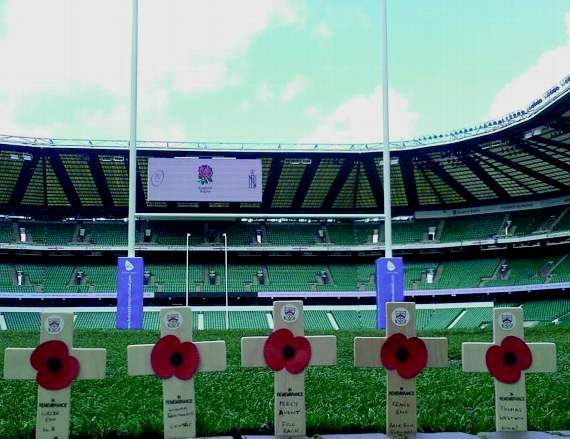
TWO representatives of Wellington RFC saw the unveiling of the Rose and Poppy memorial gates at Twickenham as the 100th anniversary of the start of the Battle of the Somme approaches.
The England Rugby Football Union is staging a four-year commemoration to help clubs and schools mark the centenary of the Great War.
Brian Lett and Mike Brewer also took the opportunity to place five crosses on the hallowed turf in memory of the five Wellington rugby players who made the ultimate sacrifice.
Brian has researched the men behind the names as outlined here.




Wellington RFC was founded in 1874 and was thriving in the years leading up the First World War. In the 1913-14 season, the last before the War, it ran three sides: First XV, Second XV and Third XV. The Great War was to take the lives of four of its regular First XV and one of its Second XV, all of them were born and bred in Wellington. The First XV played 30 matches that season against local rivals such as Taunton, Bridgwater, Weston-super-Mare and North Petherton.
The first to sacrifice his life for his country was the Number 8, Henry Walter Eno, perhaps a larger target than many. Sergeant Henry Eno, Distinguished Conduct Medal, was killed in action on December 10, 1915, far from home, in Mesopotamia. He was 24 and had won his medal only three months earlier for conspicuous gallantry when commanding his platoon under fire. Henry had worked, like his father, as a mason. He and his younger brother Frank had both played in the back row for the Possibles against the Probables at the beginning of Wellington’s 1913-14 season but Henry had gone on to win himself a regular place in the First XV.
The next two to die were both killed on the Somme within eight days of each other. William Braithwaite was 23 and played centre in the First XV. He had worked as a warehouseman in a wool factory before the war. William served as a bombardier in the Royal Field Artillery and was killed on August 14, 1916.
William’s sometime fly half, sometime fellow centre or wing, Thomas Westcott, 30 years of age, was killed on August 22, 1916. Thomas was a private in the Gloucestershire Regiment. When young William Braithwaite had first played for the Wellington First XV, Thomas Wescott was one of the established players in the back line to whom William would have looked for advice and encouragement. Thomas had worked as a percher – a cloth inspector – in a wool factory.
Henry Eno’s younger brother Frank, also a back row player – although he could also play prop – was killed in Egypt on November 23, 1917. Frank was by then 23 and, like his brother, a sergeant in the Somerset Light Infantry 1st/5th Battalion. As a youngster before the war he, like his father and his brother Henry, had worked as a mason. He may well have played the odd game for the First XV but was a regular in the Second XV.
The full back, Percy Clarence Avent, almost made it past the final whistle. Percy’s parents had at one time run the Half Moon public house in North Street, Wellington, and he himself had worked as a mechanic in Exeter while playing rugby for Wellington. He was engaged to be married. Percy was a Lance Bombardier in the Royal Field Artillery, with whom his centre, William Braithwaite, had also served, and Percy had been recommended for the Military Medal in 1917. Percy survived the end of the war but only by three months. In the appalling conditions of the trenches, he had succumbed to what was diagnosed as bronchial pneumonia – possibly not helped by poison gas – was evacuated home but lost his battle for life on February 15,1919, aged 26.
Lest We Forget – compiled by Brian Lett.
Sources: Wellington Weekly News, Our Boys by Mike Perry and Ray Hitchcock, Wellington RFC Roll of Honour.
If anyone has any further information, pictures from that time etc Brian would be delighted to hear from them. Email [email protected]
Comments
This article has no comments yet. Be the first to leave a comment.