

The Friends of the Grand Western Canal AGM
AS many of you will know, historically railways nationally saw the demise of the slower canal systems allowing the transport of goods and passengers to be much quicker. However, in the 1960’s, some rail networks also closed with a preference for the use of the increasing road links.
Fortunately, thanks to willing volunteers and forward thinking councils, many canals have, and still are, being restored and heritage railways have become widespread across the UK.
The Grand Western Canal once linked Firepool Lock, Canal Road in Taunton to Tiverton Basin as a flourishing trading route. The canal was eventually bought out by the Bristol and Exeter Railway Company in April 1865 to close down the transport competition.
The Somerset section, although now unwatered, is still accessible by footpaths which can be explored and where the remains of the first, commercially successful, historic boat-lifts can be seen.
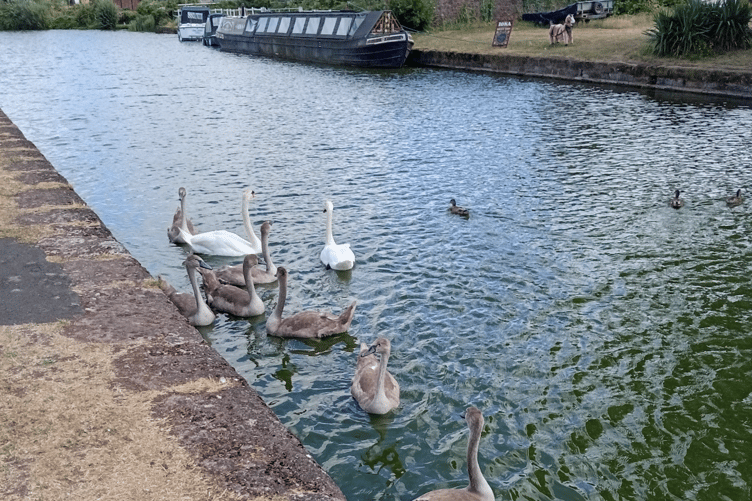
The Devon section remained as a canal due to the quarry trade of Limestone to the lime-kilns of the day. Ownership then passed to Devon County Council and became a popular Country Park and Nature Reserve with horse-drawn barge, water sports and other activities.
The canals and railways have continued to be linked in many ways, so for this year’s AGM the Friends of the Grand Western Canal welcome the West Somerset Railway for a presentation about their popular Heritage Railway. This interesting presentation will include a virtual journey from Bishops Lydeard to Minehead as well as its history and future plans.
This is an open event and free to everyone who is interested, so please come along to hear about our local Heritage Railway as well as finding out how the 'Friends GWC' support and preserve the canal in Somerset and Devon.
The AGM will be held on Saturday, October 10 at the Beambridge Inn, Sampford Arundel starting at 2.30 pm. For further details : [email protected]
 Behind the ambulance call centre scenes when you ring for medical help in Somerset
 Wellington charity launches new group to help people with dementia enjoy the outdoors
 Somerset Council defends customer service team despite 20-minute wait complaints
 Wellington council gives young people a voice with new project
Sampford Arundel Gardening Club - Dazzling Dahlias
SEPTEMBER is the first meeting in the club’s year after its August holiday, and what better way to start it than with a talk on “dazzling dahlias”, which are in flower from July to November. We welcomed Bella Given for her third visit to the club and she described her journey with dahlias as “travelling from discovery through delight to delirium”. Bella was a garden designer who moved to Devon 12 years ago when she started growing veg and cut flowers. Dahlias have become an increasing favourite and with successive house moves, she has grown about 90 different varieties in beds for cut flowers and in pots.
Bella’s generously illustrated talk took us through why and how we should grow dahlias, with tips on successful growing and combating of pests and diseases. For Bella the decision to grow dahlias is a no-brainer, being highly productive and offering every colour except blue, in a wide range of size and shapes. The only decisions she said, are where to grow them and in which colours, sizes and types.
The important things to remember when growing are that dahlias originated in Mexico and so like sun and warmth. To promote bushy growth and maximise flower heads they should be pinched out to three or four sets of leaves. If growing in borders the taller varieties used for cut flowers need either staking or supporting by other plants. Dahlias grown in pots should always be lifted, while those in borders can be lifted in November or if left in the ground, protected from winter wet and cold with a compost mulch. Lifted tubers can be split (with three to four tubers per plant) and potted up in March and planted out in May.
When growing in pots, these should be larger than 30cm, filled using fresh compost plus fish, blood, bone, and top dressed with grit. Bella’s growing tips included watering twice a week in dry weather and feeding every week from July or August, with double concentrate in September and triple in October. Deadheading should be on a weekly basis.
Dahlias can suffer from leafy gall, crown gall and powdery mildew; both leafy and crown gall are caused by bacteria, any infested plants should be thrown away, and all pots, tools and secateurs thoroughly sterilised to prevent this occurring. Powdery mildew is a fungal disease that thrives in high humidity and looks like white powder on the leaves; it can be treated with a proprietary spray.
The plants can also be infested by spider mite, slugs and snails, and earwigs. Although earwigs are great predators of aphids, they can cause leaf and flower damage, so inspect plants regularly and remove any that are found; they can be deterred by companion planting of dill. Spider mites suck the sap and can be treated with horticultural oil or a suitable spray. Slugs and snails love dahlia leaves; treat using the usual methods such as by placing pots of slug pellets away from the dahlias, checking for and permanently removing, and water nematodes into the beds in April.
On October 8 we host the Pottinger Quiz, an annual four-club gardening brain teaser, and on October 15 we take a coach trip to the 56-acre gardens of Batsford Arboretum, near Moreton-in-Marsh. Further details on these and all Sampford Arundel Gardening Club activities are available from Sue and Nick on 01823 672662.
Friends of The Museum of Somerset (FOTMOS)
THE Friends of The Museum of Somerset (FOTMOS) were pleased to welcome back to their September meeting Peter Snowden to talk about Signs Of The Times - items from the past still to be seen on our streets today, normally unnoticed or just accepted as being part of the streetscape. Some still serve their original purpose, others are incorporated in more modern developments; a few are just abandoned. Further investigation into them reveals many stories to be told.
Peter started with old cast-iron infrastructure: drainage covers, railings, structural ironwork - these have local engineering names stamped directly into the metalwork. Examples include Allen & Son who took over the Tone Bridge Foundry in 1872, followed by Easton & Bessemer, Easton & Johnson, Stevens and Samson. In 1885, Taunton was the first town to have an electricity supply and there are still a few substations dating from that time: half-timbered buildings, one can be seen in East Reach.
Postboxes are well worth looking at. They bear the cypher of the sovereign from when they were installed - there is a King Edward VII wall postbox located in Staplegrove Road. Two K6 red telephone kiosks - the Jubilee versions designed by Sir Giles Gilbert Scott in 1935 - still stand outside the Market House in Taunton, although many others have been re-purposed in this age of mass mobile phone ownership.
The Pizza Express building in Bridge Street displays the name Goodlands on its stone frontage. This was the name of the coal merchants who worked in this area and left money for Goodlands Gardens to be created for the town. The building then became used by Taunton Tyre Company.
Many of the old Taunton buildings have been converted into flats - the former Hatchers Depository in Cheddon Road, the Union Workshop in Trinity Road and the former YMCA in Lower Middle Street among them, though their original signs are still in place.
The next talk on Tuesday, October 20, will be given by Paull Robathan on Connections from Undersea Cables to the World Wide Web, at 7.30 pm for our last session this year in the Great Hall at the Museum. If you would like to join us, please email [email protected].
Lauraine Newcombe (FOTMOS)
Wellington and District Townswomen’s Guild
FOR their September meeting at Lodge Close Hall, the assembled members of Wellington & District Townswomen’s Guild welcomed their guest speaker, Susie from Age UK Somerset.
Susie gave a very interesting and informative talk about the remarkable wealth of resources provided by Age UK, predominantly to those members of the community in their 60s and above.
Much of this support is provided by trained volunteers, and includes various Ageing Well and Falls Prevention activities and exercise classes, the Wellbeing befriending service and Memory Connections groups.
Also available, by phone, on line or in person, are information, advice and help on all sorts of topics of use to older people, such as applying for a Blue Badge, obtaining benefits and allowances and accessing social care.
Members agreed that it was very good to know that such a wide range of services is available, as many had been unaware that there was so much on offer.
After Susie’s talk, refreshments were served, the raffle was drawn and the chair, secretary and treasurer gave their reports.
Members were reminded that the next meeting, at 2.30 pm on Monday, October 12 at Lodge Close Hall would be the Harvest Festival and they were encouraged to bring along items suitable for the ‘silent auction’, such as garden produce, jams and pickles or cakes and bakes.
New members are always made welcome, so do come along if you are thinking of joining this friendly group.
Comments
This article has no comments yet. Be the first to leave a comment.