
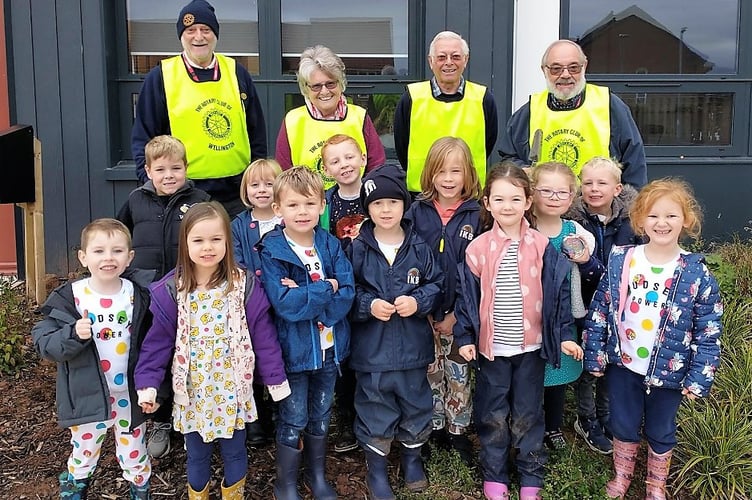
Pupils in Reception and Year 1 classes at Isambard Kingdom Brunel Primary School (IKB), with a little help from Rotary Club of Wellington members, helped plant 500 crocus bulbs in the beds along the front of the school, to create a spring purple crocus welcome to the entrance.
The purple crocus is a symbol of Rotary’s worldwide polio campaign, with its colour representing the purple dye used to mark the finger of a child who has been immunised.
Rotary’s pledge for a polio free world was made in 1985, when there were 125 polio endemic countries, and hundreds of new cases every single day.
Thanks to Rotary, and the support of our partners in the Global Polio Eradication Initiative, there are now just two countries still classed as endemic: Pakistan and Afghanistan, but no child anywhere is safe until every child has been fully vaccinated.
To finish the job, over 2 billion doses of oral polio vaccine still have to be administered, to more than 400 million children in over 50 countries, each and every year. We have to have zero cases of polio and zero positive environmental samples before the world can finally be certified polio free. That’s why Rotarians, governments, non-governmental organisations and the public are working together to raise the additional $1.5 billion needed to eradicate polio for good.
The Rotary Club of Wellington has always played its part in the End Polio Now campaign, annually donating to the cause from its charity account.
This year members of the Rotary Club of Wellington have distributed 4,000 crocus bulbs to commemorate Rotary’s achievement but also to remind everyone that we still need support to ensure that Rotary fulfils its promise to the children of the world that polio will be eradicated.
In addition to the 500 bulbs planted at IKB, 500 corms have been given to Court Fields School and 100 to the Nynehead Under 5s Pre-school. The remainder have been sold through Rotary’s Pop-up Shop. It terms of the global commitment, the money raised, some £300, may seem like a drop in the ocean but it is sufficient to pay for 1500 doses of the vaccine.
IKB pupils help plant bulbs
Comments
This article has no comments yet. Be the first to leave a comment.