
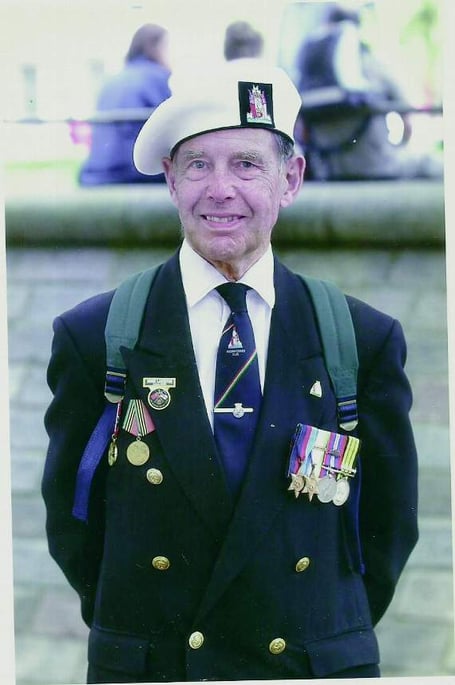
THE family of former Wellington School chaplain the Rev Derek Laughton received the French Legion of Honour the day before his funeral.
Mr Laughton, who was awarded the medal for his part in the D-Day landings in 1944, was also a veteran of the Atlantic Convoys and Arctic Convoys, and the campaign in the Far East, in the Second World War.
He was a gunnery officer on HMS Oribi, part of the 17th Destroyer flotilla, in the D-Day Landings.
His widow, Dawn, who lives in Pyles Thorne Road, Wellington, said: “Like most people he said very little about the war. But I know he went ashore [in the D-day landings] because a French farmer gave him some cheese which was very pungent when he returned home!”


Mr Laughton was 92 when he died in February and at his funeral at St Michael’s Church, Galmington, his son Adrian read the lesson and his daughter Fiona read Tennyson’s poem ‘Crossing the Bar’.
Mr Laughton, who was at Wellington School from 1964 until 1973, also left children Clare and Christopher.
He joined the school from Burton-on-Trent, saying at the time that the reason he accepted the post was because of his immediate liking for the headmaster, James Stredder.
He moved to Sussex when he left but he kept his Wellington house and returned to the town in 1988 when he retired.
The Legion of Honour is the highest French order for military and civil merits, established 1802 by Napoleon Bonaparte.
The Rev Derek Laughton was one of three Wellington men honoured in December, 2014, for their part in transporting crucial supplies to Russia. He was 89 at the time.
Counsellor of the Russian Embassy Sergey Nalobin presented Ushakov medals to the men of the Arctic Convoys at a special ceremony at County Hall, Exeter. The other local men were George (Jack) Waspe and Ronald Insall.
The Arctic Convoys sailed through blinding snow storms and darkness under a barrage of attacks from German U-boats and fighter planes to deliver vital supplies to the Soviet Union in northern Russia.
More than 3,000 men died during the maritime campaign that Winston Churchill was said to have called ‘the worst journey in the world’. By May 1945, the Arctic route had claimed 104 merchant and 16 military vessels.
The Foreign Office initially did not allow Russia to honour the veterans as doing so would break its rules not allowing British soldiers to receive a foreign medal if the act happened more than five years ago.
But following a concerted campaign in 2013, it allowed an exception to the rule and President Putin presented the first medals during his visit to London in June last year.
Comments
This article has no comments yet. Be the first to leave a comment.