
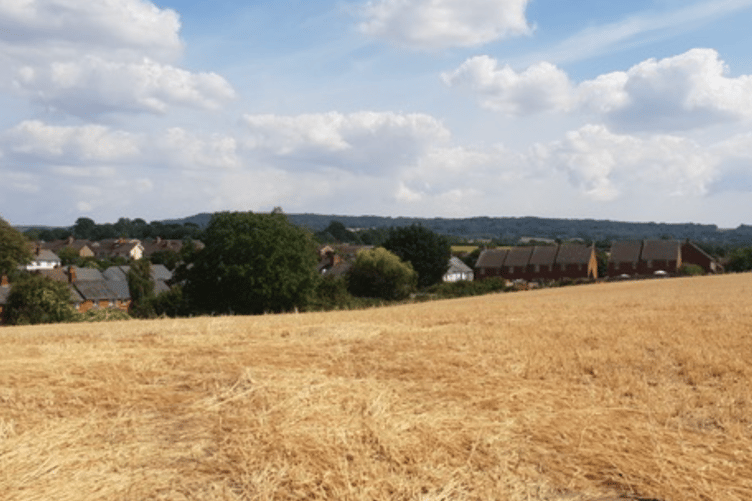
That the African Lilies in the front garden succumbed to last month’s heat and drought says it all. In a year that has seen temperature records being broken repeatedly, July 2026 ended up in a class of its own. Not that there was any abnormality at the start.
Wednesday, July 1, was a pleasant summer’s day, being warm with a light breeze from the west, followed by a cloudy night with a smattering of light rain to temporarily lay the dust. The next day was windier and quite fresh, but after that things quietened down with high air pressure settling over southern Britain.
According to the Met Office, in Somerset a heatwave is three successive days with a maximum temperature of 26⁰C (79⁰F) or higher. With wall-to-wall sunshine, that threshold was exceeded on Friday, July 3, and we then endured conditions above the heatwave threshold for twenty-one consecutive days from July 5. Temperatures in Wellington peaked at a stifling 35⁰C (95⁰F) on Friday, July 10. That set a new record for the month, while the week commencing Monday, July 6, was our hottest ever with an average daily maximum of 32.3⁰C (90⁰F). In the summer of 1976, that was the extreme maximum recorded in this area, in a mere twelve-day heatwave.
In a country where summer was reputedly “three fine days and a thunderstorm”, day after day of unbroken sunshine almost became tedious, though it was actually cloudy first thing on Sunday, July 19. Adding to our discomfort, nights were generally very warm too, with minima from mid-month onwards frequently in the range 15⁰ – 18⁰C (59⁰ – 64⁰F).
After the exceptionally dry spring, and no significant rainfall since June 7, there was an increasing probability of drought before the end of summer. Some local media outlets therefore became quite excited at the prospect of a wet weekend. In fact, Saturday, July 25, was sunny and hot until late on, with a very warm, dull night to follow. Early next morning it did rain – less than 1mm (0.04 inch) in the Wellington rain gauge, and it soon dried up.
It was cloudy at times during the last week, but temperatures in Wellington were again around the 30⁰C (86⁰F) mark on July 28 and 29. With the Environment Agency finally declaring our region to be in drought, a weak cold front edged in from the west, and Thursday, July 30, was rather cloudy with patchy light rain at times. That brought our total rainfall to 1.4mm (0.05 inch), just 2% of the average, making it not only the driest July but the driest month in living memory. It was also even sunnier than May 2020, during Covid-19.
.jpeg?width=209&height=140&crop=209:145,smart&quality=75)


Unsurprisingly, it was our hottest July ever, the mean temperature in Wellington being almost 21⁰C (70⁰F). For context, that is the July average for Lyon in France, five degrees of latitude nearer the Equator. Perhaps it is time for us to get really concerned.
Comments
This article has no comments yet. Be the first to leave a comment.