
SCOTLAND and Northern Ireland already have their own bank notes – and now Welsh nationalist party Plaid Cymru wants Wales to follow suit.
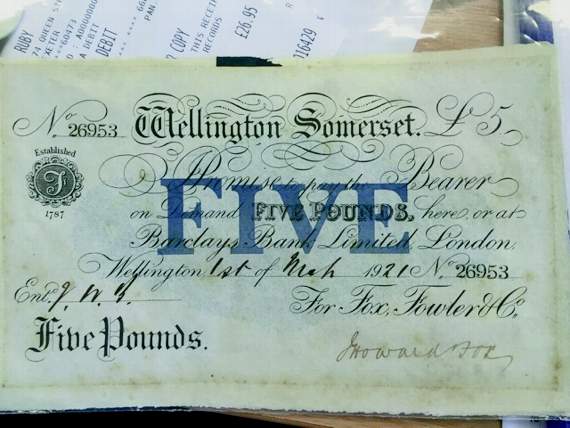
WWN readers may not know that the last private bank in England and Wales allowed to print its own notes before the Bank of England was in the town.
Many of the hundreds of banks in the country in the early 19th Century issued notes for use in their locality. In Wellington, the Fox Bank issued its own notes as early as 1787.
But the 1844 Bank Charter Act effectively gave a monopoly of bank note production in England and Wales to the Bank of England, although other banks that issued notes were allowed to continue issuing them until they were taken over or went out of business.

-teacher-and-coordinator.jpeg?width=209&height=140&crop=209:145,smart&quality=75)


By the 1920s the viability of small regional banks was threatened by the strength of the then five major national banks. Although the Fox Bank had deposits of about £3,500,000 and more than 50 branches. John Howard Fox began talks with Lloyds Bank in early 1921 and a takeover was completed later that year.
Significantly, his mother was a relative of Howard Lloyd, a director of Lloyds Bank from 1906 to 1920. John Howard Fox became a director of Lloyds Bank and remained on the board until 1949.
In its lifetime, the Fox Bank issued a few £1 notes, 26,998 £5 notes, some 5 guinea (£5.05) notes, 200 £10 notes and 2,155 £20 notes. The later issues were traditional in design, similar to the Bank of England notes of the era.
The final batch of Fox notes, 100 £5 notes with serial numbers 26901 to 26988 was issued in 1921 as presentation notes for bank branches and individuals. Those notes all have the date 1 March 1921 and are the last legal tender bank notes ever issued by a commercial bank in England and Wales.
They were all marked ‘cancelled’ either by a rubber stamp or perforations. Two notes, number 26999 issued to Gerald Fox and number 27000, issued to John Howard Fox, were marked ‘Issued as a specimen’.
Very few of the Fox banknotes are known to survive today – perhaps a dozen or so of the £5 notes. All the rest were burnt when no longer legal tender or were lost. Wellington Museum has a facsimile of a £5 note that is generally on display.
Comments
This article has no comments yet. Be the first to leave a comment.