
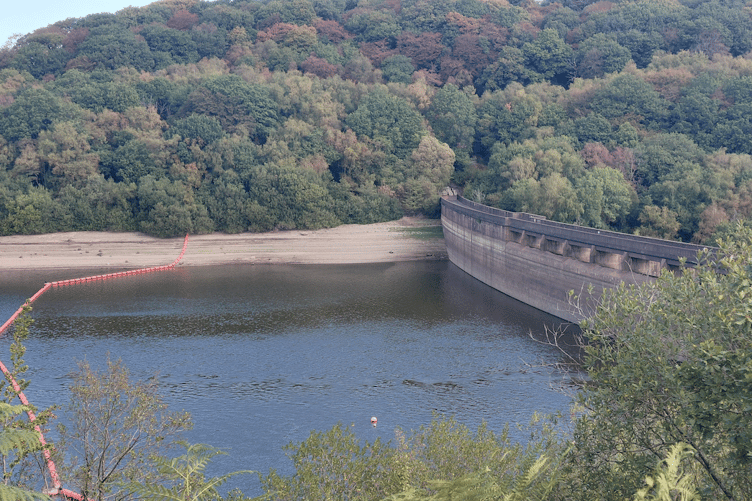
HEAVY rain every day till Christmas is needed to replenish the near empty reservoir that supplies water to Wellington.
Climate expert Simon Ratsey released the stark warning ahead of the COP31 Climate Summit.
Mr Ratsey's forecast coincided with a Met Office warning that record-breaking El Niño weather could see the UK freeze this winter.
Wellington Climate Cafe joined groups worldwide to send a crisis letter to COP31, urging world leaders to find common ground on reducing emissions.
Spokesperson for the local climate group, Stephen Tate, said: “Our message is simple: Please don't come away empty-handed.”
Wellington residents receive much of their water from Clatworthy Reservoir in the Brendon Hills. According to an Environment Agency assessment published in late October, the water storage level at Clatworthy was “exceptionally low” at 25 percent of capacity.
Simon Ratsey estimated that the reservoir built in 1958 would only be about 50 percent full by the end of the year.
He said: “The amounts of extra rainfall that the Environment Agency says we need are statistically not very probable. In a nutshell, it needs to rain heavily every day for the next two months if there’s to be any chance of the reservoir refilling by the end of the year.
“It's hard to believe that four years ago, Clatworthy was overflowing after the wettest November on record in 2022.”
Clatworthy is fed by the River Tone and supplies water to 200,000 homes in Somerset, primarily in the Taunton Deane area including Wellington.




Wimbleball Reservoir in Exmoor National Park supplies water to Exeter and East Devon and is currently at 17 percent of its capacity.
When Stephen Tate visited Hawridge Reservoir in early November, he found it nearly empty. “It had become a familiar landmark from many visits to the Quantocks over the past 20 years, I remember a beautiful lake. Now it's a giant puddle,” he said.
It is a similar story at Durleigh Reservoir which is currently at 34.4 percent of capacity.
The long-term trend for these four reservoirs has been downward due to increasing demand and extreme heat events, with water levels 20 percent lower than in 2021.
Simon Ratsey said: “Big increases in demand for water since the reservoirs were built mean that it is rarely possible to hold back supplies in reserve so most years, water levels drop significantly earlier and more rapidly than used to be normal.”
Despite 2026 being the hottest summer on record, Wessex Water said in August that it had no plans to increase Clatworthy's capacity.
The privatised water company owned by Malaysian company YTL Power International has a hosepipe ban in place for the whole region, the first since 1976.
Climate expert Simon Ratsey added: “I do not expect the current hosepipe ban to be lifted any time soon.”
The Met Office suggests a sudden stratospheric warming (SSW) is developing that could bring colder weather to the UK in the next three weeks.
Mr Ratsey added: “A cold, dry spell wouldn’t help fill our depleted reservoirs. Quite the opposite. An SSW tends to push sustained rainfall away.”
Comments
We've recently changed our login process. If you have an account for commenting, you will need to re-register on the login window.
This article has no comments yet. Be the first to leave a comment.