

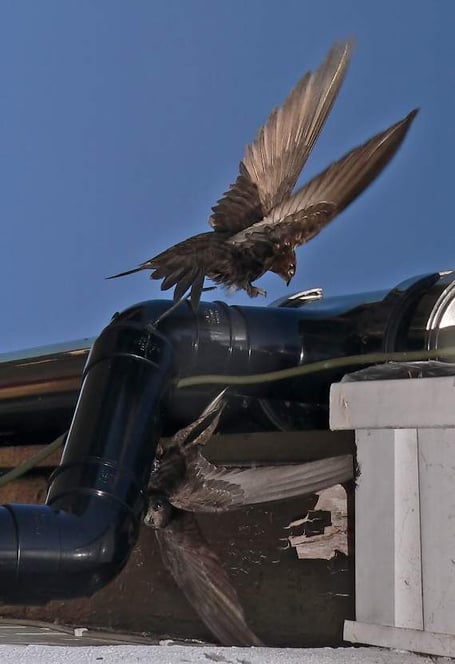
IT is the first week of May and swifts are about to reappear in Wellington after migrating more than 6,000 miles from their wintering grounds in Africa. And a recently established group, Taunton Deane Swifts, is ready to welcome them back.
Often confused with swallows and house martins, swifts are the latest of our returning summer migrants and the first to leave, too. It takes them just 12 weeks to raise their young and then they are off again on the long flight south.
Swifts nest almost exclusively on buildings, usually behind fascia boards and gutters, inside soffits or squeezed into small gaps under roof tiles.
When not at their nests, swifts spend all their time in the air – they eat, sleep and even mate on the wing. A swift does not land at all for the first two or three years of its life, only touching down again when it eventually returns to find a mate and raise its own family. Some claim that these extraordinary birds, in their lifetime, travel the equivalent of several times to the moon and back!




Swifts are noted for their high-pitched screeching and rapid flight. They are sociable birds, enjoying each other’s company and tending to nest in loose colonies. For the next three months, listen out for screaming parties of swifts, the birds careering around our rooftops at frightening speed, yet never colliding or striking obstacles in their path. They are avian ‘speed merchants’, but also provide an important pest control service, hoovering up vast numbers of small insects and spiders in their travels.
It is hard to know exactly where swifts are nesting – they are exceptionally clean birds, and usually enter and exit their nest-sites when no-one is looking – but the presence of screaming parties is a good sign that you may have them breeding in your area.
Surveys nationally, co-ordinated by the RSPB, suggest that swift populations are in trouble, having declined by almost half in the last 20 years. Reasons for this could include problems on their migration route, while climate change could also be a factor. But in Wellington, as across the rest of the UK, a major cause is likely to be the loss of suitable nesting places.
Simon Bament, one of the group’s co-founders, said: “Taunton Deane is a real hotspot for swifts in South-West England. Recent surveys indicate that we could have more than 200 pairs nesting here, which is fantastic news.
“But we know of many buildings that once held swifts which have either been demolished or else re-roofed, with soffits and fascia boards repaired and sealed, and roofs better insulated.
“We could be doing so much more to replace these lost nest-sites. There are many nest boxes available that are designed specifically for swifts. Our group is keen to help people make their homes more swift-friendly and can advise about suitable boxes.
“New buildings don’t tend to have the nooks and crannies that swifts require, but special swift boxes or ‘swift bricks’, are easily installed and can be a really neat solution to the problem.
“A great example is at Killams Park, Taunton, where Summerfield Homes is including swift nest-sites on the gable ends of many properties. We’d love to see this sort of approach being rolled out on new housing elsewhere. It could make a huge contribution to reversing the decline in breeding numbers.”
In collaboration with the RSPB, Taunton Deane Swifts is surveying swift populations in the area and would be keen to hear from anyone who thinks they may have breeding swifts in their neighbourhood. The group can also provide advice and support to anyone wishing to encourage swifts to nest on their property. To get in touch, and to find out more about the group, email taunton
Comments
This article has no comments yet. Be the first to leave a comment.