
THE third heatwave in Wellington lasted longer than the one in 1976 with no measurable rainfall during July, according to a report from the Wellington Climate Cafe.
The recent heatwave, the third of the year, was the longest ever heatwave recorded in Wellington.
It persisted for a record 21 days from Sunday, July 5 to Saturday, July 25 eclipsing the 1976 heatwave that lasted just 12 days.
Climate data released by local weather expert Simon Ratsey shows that July 2026 was the hottest month on record and July 10 the second hottest day on record at 35C.
It was also the driest month on record with no measurable rainfall recorded during the whole month.
The Met Office defines a heatwave as the moment the daily temperature passes a threshold for three or more days in succession. The threshold for the Wellington area is 26C.
And while solar panels may have benefited, that’s in sharp contrast to infants and the elderly, especially those with lung and heart conditions, and outdoor manual workers, who were at high risk.
According to the UK health and Safety Executive, elderly people aged 65 and above and babies and young children were in the most at risk category.
Researchers from Imperial College London and the London School of Hygiene & Tropical Medicine estimate 2,700 extra people in England and Wales died from heat-related deaths during the May and June heatwaves.
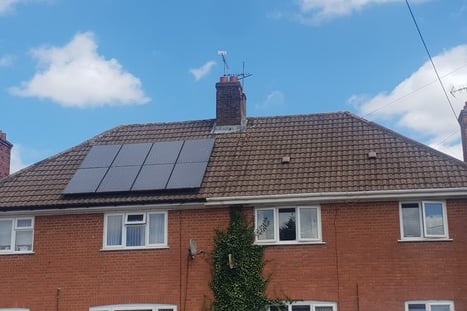
The extreme weather was, however, a bonus for the 1.9 million households in the UK producing solar energy.


Data produced by energy analyst Utility Bidder shows the first two heatwaves in May and June generated 1.85 trillion watts of domestic solar power; enough to make 18.5 billion cups of tea, watch Netflix for two million years, or drive 6.5 billion miles in an EV vehicle.
Think-tank Ember says the daily output of rooftop solar systems during a heatwave provide enough power to run air-conditioning for five hours a day.
Some council properties on the Priory estate in Wellington were fitted with solar panels as part of the UK Government's Warm Homes in 2025. One tenant whose export tariff was activated at the beginning of the July heatwave reported their solar panels generating double the amount of energy they were using, however he was concerned other tenants had not had not yet received their paperwork.
Council tenants need two documents from Somerset Council to register a solar system for a Smart Export Guarantee (SEG), explained Simon Ratsey.
The first is issued by the Microgeneration Certification Scheme (MCS), the UK government regulator for solar installations under 50KW. The second known as a G98 is issued by the Distribution Network Operator (DNO) that serves Wellington - the National Grid.
He warns, however, that panels become less efficient at converting available sunlight the higher the temperature rises above 25C.
Simon said: “To properly maintain solar panels, clean them at least once a year with a cleaning agent that is pH neutral. Avoid using alkaline solutions that may corrode the panel surface and rubber seals.”
Comments
This article has no comments yet. Be the first to leave a comment.