
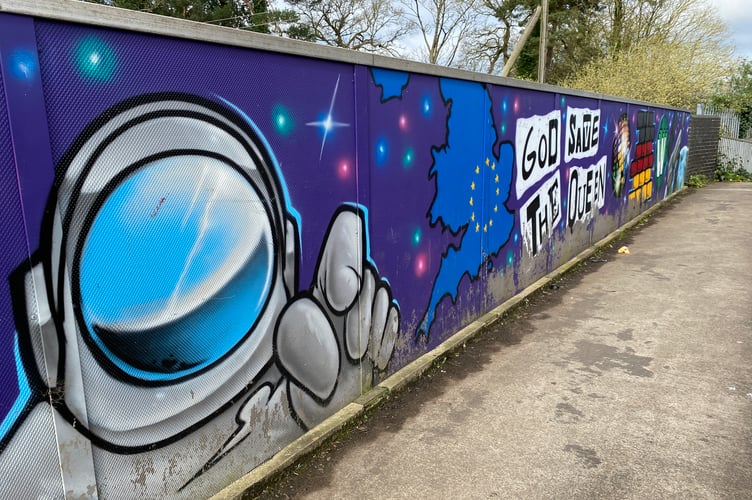
Historical figures from Wellington’s past could be included in a new mural which is being earmarked for the Tonedale footbridge.
Field Marshal Arthur Wellesley, the Duke of Wellington, famous for leading the British and Allied Forces to victory at the Battle of Waterloo over Napoleon Bonaparte’s French Army in 1815 is one of the names being suggested to be included in the planned new mural.
Another name listed is Sir John Popham, of Wellington, who served as Lord Chief Justice of England from 1592 to 1607, and presided over the trials of Sir Walter Raleigh in 1603 and the conspirators of the Gunpowder Plot, including Guy Fawkes, in 1606. He was also involved in the trial at Fotheringhay Castle of Mary, Queen of Scots, in 1587, which resulted in her execution.
Legendary civil and mechanical engineer Isambard Kingdom Brunel is also mooted as a potential face on the mural after he designed the 1,000-metre-long Whiteball tunnel, which opened in 1844 not far from Wellington, along with the author of Robinson Crusoe, Daniel Defoe, who was chased out of town by beggars when in Wellington in 1724.
The Fox Family – such a well-known and important part of Wellington’s history – is likely to be featured if the mural project does go ahead.
Wellington Town Council’s economic development committee is considering repainting the mural on Tonedale Bridge. The bridge was last painted in 2022 as part of the late Queen Elizabeth II’s Platinum Jubilee celebrations.
But this time the council would like to reflect a timeline of important events and people that have helped make Wellington what it is today.
An online survey will go live in September for three weeks, asking people for their views, and paper copies will be available from Wellington Library and the Kings Arms Community Hub.
The survey was drawn up by the council’s events working group and supported by the economic development committee at its meeting on August 12.
Possible historical events which could be included in the new mural have been listed as the Roman occupation, the Monmouth Rebellion of 1685, the town centre being destroyed by fire in 1731, the First World War of 1914-18, the Second World War in 1939-45 and the invention of Welly-Wanging in the 1970s.

Places highlighted as possible inclusions for the mural include the Old Well at Rockwell Green, Wellington Park, St John’s Church and the Wellesley Cinema/Theatre.
The mural initiative is all part of next year’s planned Wellington Day – a community event to celebrate the town and its heritage.
Cllr Steve Mercer tentatively asked at the economic development committee meeting why there was a question in the survey about people’s ethnic group or background.
It was also said that if the council wanted to go for external funding for the mural project, the question of ethnicity would be brought up.
Committee chairman, Cllr Keith Wheatley, said: “It is a hoop we have to jump through.”
Comments
This article has no comments yet. Be the first to leave a comment.