
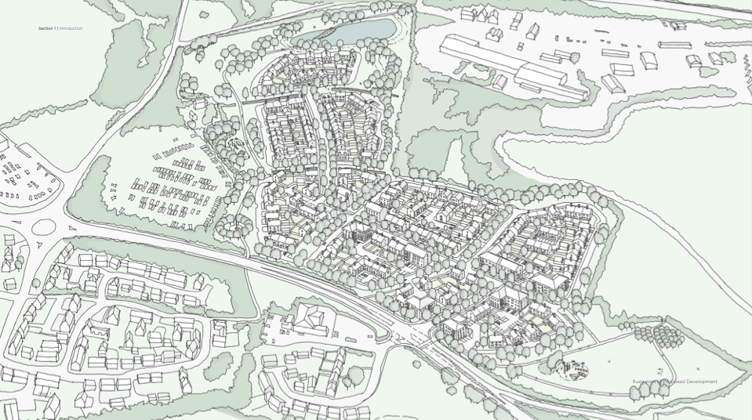
TOWN councillors will on Monday (September 7) consider their views on the latest large-scale housing proposals for Wellington.
But, they will be told the Carden Group’s planning application for 225 homes off Taunton Road, soon to be renamed Queen Elizabeth Way, do not actually lie in Wellington.
Chief executive Dave Farrow said in a report for councillors the site behind the Cadeside caravan and motorhome park opposite the Lidl supermarket is actually in West Buckland parish.
Mr Farrow said councillors would need to recognise that although the site was outside the town boundary, the practical effects of the development were likely to be substantially felt by Wellington and not West Buckland village, nearly two miles away.
He said the site was ‘functionally, an extension of Wellington and residents ‘are highly likely to rely upon Wellington for their day-to-day needs’.
Mr Farrow said: “A development of up to 225 dwellings will inevitably place additional pressure on local services and infrastructure.”
He said facilities which people moving onto the new estate were likely to rely upon included:
• Town centre retail and services
• Community facilities
• Recreation and leisure provision




• Public open spaces
• Library and cultural services
• Public conveniences
• Community events and activities
• Active travel links and pedestrian infrastructure
Mr Farrow said Carden Group in its application literature was promoting the site’s proximity to Wellington and its facilities as a key sustainability benefit.
He said: “It is therefore reasonable to conclude future residents will look primarily toward Wellington rather than West Buckland to meet many of their daily needs.
“Therefore, the town could experience substantial additional demand on local infrastructure and services whilst receiving little or none of the community infrastructure levy (CIL) neighbourhood funding, or locally directed developer contributions arising from the development.
“The result is that the authority and community most affected by the development’s day-to-day impacts may not receive a proportionate share of mitigation funding.”
Mr Farrow said town councillors might want to consider requesting Somerset Council to carefully consider mechanisms to ensure contributions toward community infrastructure reflected actual patterns of use, rather than purely local authority administrative boundaries.
He said contributions for Wellington could be sought toward:
• Public realm improvements;
• Active travel connections into Wellington
• Recreation and leisure infrastructure
• Community facilities
• Town centre infrastructure
• Open space provision
• Projects which promote integration between the development and Wellington
Mr Farrow said: “Failure to address this issue risks creating an inequitable position whereby Wellington absorbs much of the impact of development while receiving limited resources to accommodate it.
“The issues raised relate to the council’s adopted vision for Wellington and the priorities identified through the Wellington Place Plan.
“The application should therefore be considered not only as a planning matter, but also in terms of its potential effect on the town’s long-term social, economic, environmental, and community wellbeing.”
Mr Farrow said it was also important to emphasise the application was a departure from the local plan which guides where development should and should not take place.
Comments
We've recently changed our login process. If you have an account for commenting, you will need to re-register on the login window.
This article has no comments yet. Be the first to leave a comment.